

Opinion pieces in the press: a tool for establishing your personal brand

Article summary
- An op-ed is a signed personal manifesto : it takes a stance, unlike a neutral news article, a press release, or an editorial.
- Timing is everything : whether reacting to current events, supporting a strategic shift, weighing in on a major debate, or regaining control during a crisis.
- The 5 golden rules : authenticity, impactful structure, solid argumentation, dynamic writing, and emotional engagement. It is a powerful tool for building credibility and influence as a leader.
What if your voice could shift the status quo, challenge conventional wisdom, and resonate far beyond casual conversation? Executive, entrepreneur, expert? It doesn't matter. Everyone has a unique story, a singular perspective that deserves to be shared.
When every tweet can spark a movement and every post can go viral in seconds, an opinion piece is no longer just a stylistic exercise. It is your strategic weapon, your personal megaphone to make your vision heard and leave a lasting impression.
But be warned: writing a compelling opinion piece is a true art form, a subtle blend of conviction, style, and strategy.
Whether you are an intimidated beginner or a seasoned communicator, we will attempt to decode the secrets of a thought leadership piece that doesn't just exist, but truly energizes public debate.
What is a thought leadership piece in PR?
Definition and the unique DNA of a thought leadership piece
An opinion piece is not just another article; it is a personal manifesto, a committed text that takes a stand, challenges the status quo, and leaves a lasting impression.
Far removed from journalistic analysis or a blog post, a thought leadership piece is a bold statement, following specific conventions with a clear ambition: to make a voice heard, a conviction, a warning, or a vision on a given subject.
The 4 key points that distinguish an opinion piece from other editorial formats:
Op-eds vs. other formats
Why op-eds are crucial today
The need for original commentary has never been greater:
- The media are constantly seeking differentiated content : beyond raw information, they are looking for op-eds that offer bold expertise and strong opinions.
- The audience, for its part, is demanding fresh perspectives : it is clear, personal, and nuanced viewpoints that stand out and drive engagement.
- The digital platformshave multiplied the spaces for expression : online op-eds, specialized media, influential newsletters, LinkedIn, professional blogs… These are all opportunities to make your voice heard and expand your reach.
The op-ed: What? Who? When?
An op-ed, for whom?
Before writing an op-ed, it is essential to ask yourself a simple question:
Who am I speaking to?
This reflection guides the tone, the level of language, the choice of arguments, examples, and even the distribution channel. The more targeted the message, the greater its impact.
An opinion piece is not meant for everyone — it is meant for the right people, at the right time, provided you have clearly defined your target audiences.
Why (and when) should you write an op-ed?
In a world saturated with information, the relevance of an op-ed does not rely solely on the substance of the message — the timing of its publication plays an equally crucial role.
It is this timing that determines the resonance, the visibility and the impact of speaking out.
A matter of strategic timing, down to the details
Reacting to current events: capturing attention in the moment
When news breaks, media outlets and readers are looking for analysis, insights, and clear points of view. Publishing an op-ed at that moment means seizing the opportunity to make a unique voice heard above the noise, by offering expert insight, a broader perspective, or constructive criticism.
Supporting a strategic shift: giving meaning to action
Mergers, repositioning, fundraising, social commitments… these deserve more than just a press release. An op-ed allows you to provide context, add a human touch and drive engagement.
This is an opportunity to share the vision behind the movement, explain its values, and involve stakeholders in the narrative.
Participate in a defining debate: anchoring your thinking for the long term
Major societal or innovation debates (AI, climate, inclusion, digital sovereignty, etc.) offer regular but demanding windows for expression. An op-ed allows you to establish a clear position, to make your mark on the intellectual or industry landscape, and to move the conversation forward.
Manage a crisis or a tense moment: regain control of the narrative
In times of crisis, silence is often interpreted as an admission of guilt. Speaking out through an op-ed allows you to rebuild trust through transparency, analysis, and accountability.
An op-ed structures the narrative, provides a framework, and can even initiate a path out of a crisis by demonstrating a willingness to engage in dialogue.
The right message, at the right time, in the right format
Publishing an op-ed at the right time means speaking up when it carries weight.
- Too early: the audience isn't ready yet.
- Too late: the opportunity has passed.
The process therefore relies on active monitoring, a nuanced reading of the context, and the ability to turn an intention into an impactful message.
The value of an op-ed in my PR strategy
Integrating an op-ed into your public relations strategy is a powerful lever to assert your voice and establish your influence.
An op-ed, a credibility accelerator
Unlike a press release or a simple statement, an op-ed offers a space for personal and reasoned expression.
For an executive, this means being able to express their vision directly, their convictions, and their command of the issues, without filters or dilution.
This assertive approach to communication builds trust with the media, partners, and stakeholders : it demonstrates the stance of a committed expert, capable of anticipating, analyzing, and proposing solutions.
An op-ed, a powerful vector of influence
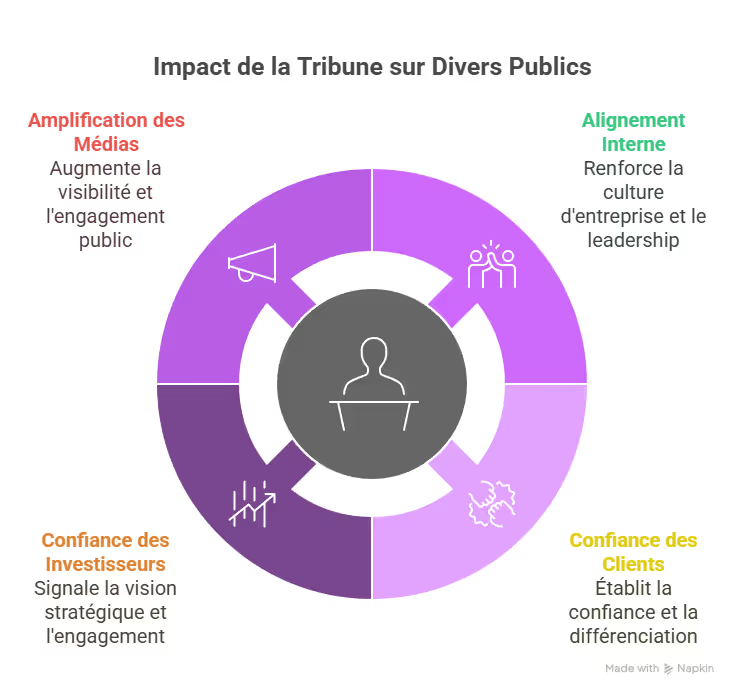
Thanks to its personal and unique nature, an op-ed facilitates the creation of emotional and intellectual connections with key audiences: clients, employees, investors, and journalists.
It establishes the executive as a reference in their field, a key player in public and industry debates.
A complementary strategic tool
Integrated into a global PR plan, an op-ed is part of a multi-channel strategy : it can be shared on social media, in newsletters, picked up by traditional media, or even serve as a foundation for public appearances (conferences, interviews).
This synergy maximizes the message's reach and brand visibility, while consolidating the executive's reputation as a thought leader.
Need help? Call on a specialized agency
Writing a compelling op-ed requires time, experience, and a strong grasp of editorial standards. If you lack the resources or want to avoid clumsy communication, outsourcing this task is often the best solution.
Linker agency supports brands and executives with their communication challenges, particularly in sensitive situations. From strategic monitoring to controlled public speaking, we offer:
- An e-reputation audit and proactive monitoring to anticipate key issues
- The development of a tailored communication plan
- Response management and effective multi-channel communication
- Personalized executive coaching or media training to prepare for public speaking engagements
Entrust us with your writing your op-ed : give your voice the reach it deserves, with relevance and impact.
How to write an effective op-ed?
Writing an op-ed is not just about writing another article: it is a true expression of self, an intellectual manifesto that reveals your uniqueness.
The art of the op-ed relies on a subtle blend of authenticity, creativity, and rigorous argumentation, allowing you to leave a lasting impression on your readers.
Key elements for writing a punchy op-ed:
The 5 golden rules for a successful op-ed
To captivate and convince, your op-ed must follow five key principles:
- Absolute authenticity
Be yourself, stand by your positions even if they are controversial, and avoid political correctness. - Impactful structure
Start with a strong hook, follow a logical progression, and end with a memorable conclusion. - Solid argumentation
Support your points with facts, illustrate with concrete examples, and keep your reasoning clear. - Dynamic writing
Favor short sentences, vary the rhythm, and choose precise, vivid vocabulary. - Emotional engagement
Build a genuine connection with your reader, spark a reaction, and inspire action.
Writing specifics: anatomy and styles of op-eds
A powerful op-ed is defined by an assertive and committed tone, a dynamic, non-linear structure, vivid and direct language, and a clear intent: to provoke thought and spark debate.
Depending on your goals and audience, you can adopt different styles:
- Analytical op-ed : a rigorous intellectual approach with a reasoned argument, aimed at decision-makers and experts.
- Testimonial op-ed : a personal, emotionally charged narrative that speaks to the general public.
- Forward-looking op-ed : a vision focused on the future with bold projections, suited for innovators and influencers.
-
The art of editorial uniqueness and developing your personal signature
To stand out and captivate your readers, you must deploy your personal signature with boldness and authenticity.
Here are some practical tips to help you create an op-ed that truly reflects who you are:
Whether you choose an analytical, testimonial, or forward-looking approach, never forget that your strength lies in your unique editorial voice. Draw on your experiences, your background, and your convictions, and don't be afraid to take a bold stance to make your unique voice resonate.
By following these 5 golden rules—authenticity, impactful structure, solid argumentation, dynamic writing, and emotional engagement—you will capture attention and leave a lasting impression on your readers.
Bonus: mistakes to avoid and examples of inspiring op-eds
By clearly identifying the common mistakes that weaken a message, you can preserve the strength and credibility of your statement.
At the same time, drawing inspiration from compelling op-eds written by recognized leaders will give you the keys to building a powerful, authentic, and memorable speech.
Mistakes to avoid in an op-ed
Inspiring examples
Steve Jobs (Apple)
Steve Jobs was a master of the visionary op-ed. His writing was characterized by a clear and innovative technological vision that challenged conventions. His tone was both passionate and inspiring, creating a sharp break from the status quo.
He invited his readers to envision the future with boldness, making his pieces a call to innovation and transformation.
Satya Nadella (Microsoft)
Satya Nadella embodies a more inclusive and humanistic style of visionary leadership. Since taking the helm at Microsoft, he has profoundly transformed the company's culture by emphasizing empathy, continuous learning, and openness.
His tone is measured and pragmatic, yet carries a clear vision: technology should be a vehicle forempowering individuals and organizations.
Yvon Chouinard (Patagonia)
Yvon Chouinard embodies a platform that is activist and radically responsible. As the founder of Patagonia, he speaks rarely, but every time he does, the alignment between his personal convictions and his business actions is striking.
His tone is authentic, sometimes blunt, but always rooted in a vision of regenerative capitalism. He speaks not to charm, but to shake things up.

Mathieu Pimort


Have questions?

Other resources LinkedIn & Media Relations

%20Large.avif)

Go from invisible to essential in your market
Your expertise deserves to be visible, credible, and shared, both on LinkedIn and in the media.


LinkedIn communication and Public Relations agency in Paris.
