

Crisis communication agency for tech startups
For French tech startups and scale-ups: framing your message in the first hours of a crisis, or building your strategy before you need it.

7–15media hits

What should you do in the first hours of a crisis?
The first six hours determine what gets written next. The work involves establishing the facts before speaking, designating a single voice, and publishing a concise position rather than a full press release that will arrive too late. Linker defines the response strategy, arbitrates what is said and what is kept quiet, prepares the executive for media inquiries, and writes the LinkedIn statement. On your end, you need verified facts and someone available at all times. Silence is not neutral: after twenty-four hours without a public stance, others will write the version that remains indexed.
0–6hours
1line
30days
5–15k€
A startup crisis is not a corporate crisis.
62%
of journalists use LinkedIn in their work, and a third rank it as their most useful platform.
Cision, State of the Media 2026
The protocols described by crisis agencies assume an organization you don't have: a press office, a trained spokesperson, a crisis committee, an in-house legal department. In a startup, the founder is the only available face, and their personal LinkedIn account is more exposed than the company's. They have to make decisions alone, between meetings, on a subject they have never had to deal with before.
The sequence is also reversed. A startup crisis starts with a comment, a message from a former employee, or a LinkedIn thread, and only reaches the press if no one has addressed it beforehand. Journalists read these threads: a third of them consider LinkedIn their most useful tool. What gets lost is the version of the facts that will remain readable on Google and in AI responses for years to come—the version that will shape your next funding round and future hiring.
The first 72 hours, step by step
Real-world timelines, based on the crises we handle. What we do and what you do, hour by hour.
Linker does
Inventory what is circulating, who has picked it up, and the actual audience. Sort between what is verified and what is alleged.

You do
Provide access to the people who know, without hierarchical filtering.
Linker does
Draft the position, decide what to say and what to keep quiet about, and designate a single spokesperson.
You do
Validate the position and confirm who is speaking. Only one person.
Linker does
Publish a short position on the channel where the issue originated, and send an internal message to the teams before going external.
You do
Publish, do not respond to comments on a case-by-case basis.
Linker does
Handling journalist inquiries, defining talking points, and preparing the executive for interviews.
You do
Remain reachable and do not speak to any journalists off the record.
Linker does
Monitoring coverage, responding to new angles, and deciding on the right of reply if an article contains factual errors.
You do
Inform the board and investors with the same text.
Linker does
Resuming editorial focus on substantive topics, so that the crisis is no longer the most recent content associated with your name.
You do
Provides the core topics and data for the period.
What crisis support covers
Six deliverables for a crisis. Each one is produced in the hours that follow, not just advised upon.
Fact-finding
What is proven, what is alleged, what is false. Written before any statement is made, because retracting costs more than staying silent.
Response line
A concise position, sustainable over time, and usable as-is for the press, LinkedIn, and internal communications.
Spokesperson strategy
Who speaks, who doesn't, on which channel, and in what order. Internal communication comes before external, without exception.
Media relations
Handling calls, framing angles, negotiating deadlines. A journalist who gets an answer writes differently.
Right of reply
Assessing opportunity and drafting. It asks when a fact is false, not when an article is displeasing.
Crisis recovery
Resuming your editorial strategy with in-depth topics to shift what search engines and AI return when your name is searched.
The role of LinkedIn during a crisis
During a crisis, LinkedIn doesn't amplify; it exposes. It is often where the issue starts, and always where the response is read.
The founder's account
This is the primary point of exposure, more so than the company page. The statement should be published here first.
The short statement
A few lines posted quickly are better than a full press release published the next day.
Managing comments
A single collective response rather than a thread of individual replies, which automatically boosts the post's reach.
Back to normal
Resuming a steady rhythm of substantive content is what pushes a crisis down in search results.
The press arbitrates the narrative. LinkedIn sets the tempo.
Used separately, these two levers produce two versions. Used together, they produce only one.
The value of the press
Arbitration
A journalist who has your version will include it. A journalist who doesn't will write without you.
Longevity
The article remains indexed and continues to appear in search results and AI responses for years.
Authority
Third-party media carries more weight than a press release, including with your board and your clients.
Precedence
A relationship built before a crisis changes how things are written during one. It cannot be created in a rush.

The value of LinkedIn
Immediacy
Your version can be published in an hour, whereas an article takes a day.
Control
The text is yours, word for word, without any rewriting or cuts.
Proximity
Your employees, clients, and investors read it there before they read it in the press.
Continuity
You own the narrative day after day, without depending on a specific publication window.
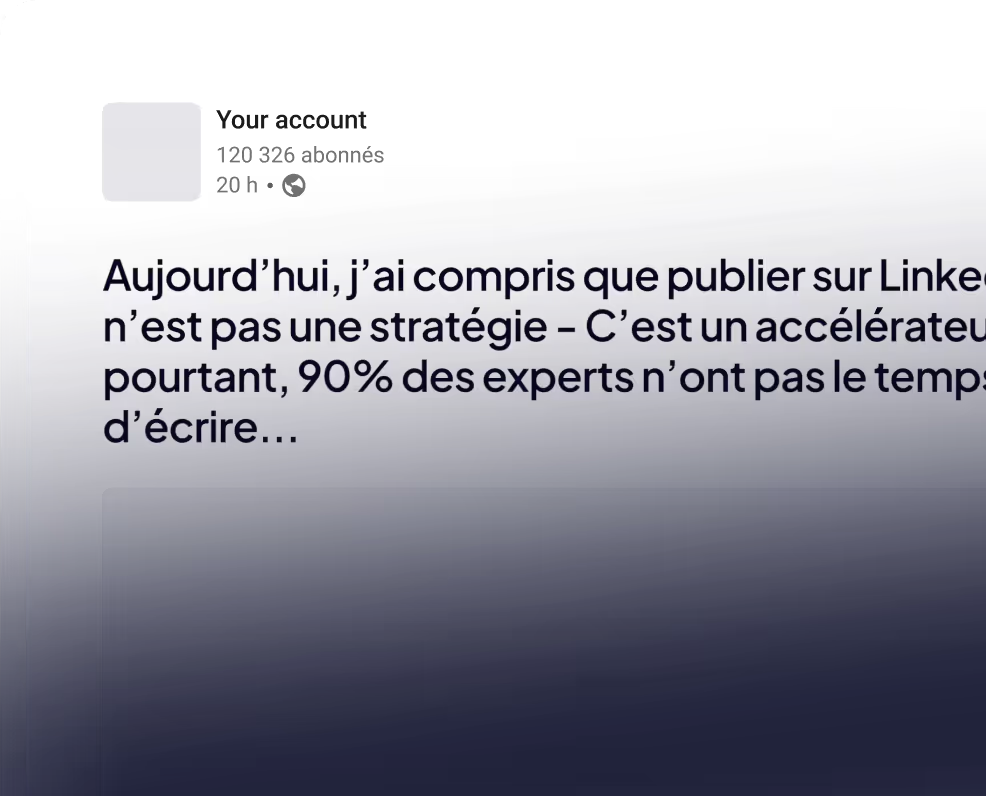
The cycle
Maintaining press relations outside of a crisis changes what happens during one. A journalist who receives information already has a contact, an address, and a history, so they call before publishing. A founder who posts regularly on LinkedIn already has an audience that reads their version first. Neither is built in the six hours following an alert.
HRTech: 7 media mentions from a single study and 322,000 reach in 3 months
7 media mentions
3 months

The 4 most common mistakes in the first few hours
Observed in crises that reach us on the second or third day, when the narrative is already set.
Waiting until you have all the facts
The costBy the time you establish the full facts, other versions are already indexed and circulating. A twenty-four-hour silence is read as an admission of guilt, including by your own employees.What to do insteadPublish what is certain within six hours, while explicitly stating what is currently being verified.
Having the company respond rather than the founder
The costA press release in the name of a company, in a team of twenty, sounds like an evasion. The audience knows that one person is making the decisions.What to do insteadHave the founder speak, well-prepared, from their own account, with a position they can defend in an interview.
Replying to every single comment
The costEvery individual reply boosts the post's reach and extends the thread by another day. The discussion shifts to the terms set by the person who started it.What to do insteadA single, pinned public response, with no individual replies for the first twenty-four hours.
Notifying the public before your own team
The costEmployees who find out about their company's position through the press become the next source. This is the most common trigger for a second wave.What to do insteadSending the internal message before any public announcement, using the same text as the external one.
Who this is relevant for, and who it isn't
Two out of every six situations are not matters for a communications agency. It’s best to say that before you call.
Your situation | Relevant | Why |
|---|---|---|
Topic circulating publicly for less than 48 hours | The window is open. What is published now is what will remain indexed. | |
Article in progress, journalist has reached out to you | The best possible time. Your side of the story can still be included in the narrative. | |
Past crisis that still appears in search results | This is no longer an emergency; it is a six-month content displacement project. | |
No crisis, you want to be prepared | This is the only time a strategy can be properly built. It cannot be improvised. | |
Ongoing dispute or active legal proceedings | The final decision rests with your lawyer. We then step in within the framework they establish. | |
Internal conflict with no public exposure | This is a human resources matter. Making a public statement would turn it into a crisis. |
How much does a crisis response cost
These are estimates, not a price list. Pricing depends on the actual exposure and duration, not on the size of your company.
Emergency response
€5k–15k
Preparation and monitoring
3.5–7k€ / month
Ongoing support
3.5–7k€ / month
Questions we are asked during a crisis
Response times, who should speak, right of reply, article removal, and when you need a lawyer rather than an agency.

Our clients' press coverage
















.svg%20(1)%201.avif)




%201.avif)



.avif)

%20(1).avif)











.avif)

%201.avif)








































%201.avif)





.avif)







%201.avif)




































Is something breaking? Call us now.
Thirty minutes to look at what is circulating, who has picked it up, and what can still be influenced. If the matter requires a lawyer rather than an agency, we will tell you.