

How do executives prepare for interviews and media appearances?

Article summary
- An interview cannot be improvised. : what passes for spontaneity is the result of methodical preparation.
- The preparation process : identify the key issues, build 3 core messages, anticipate sensitive questions, practice in real-world conditions, and debrief.
- Live : set the frame from the very first question, avoid traps, always return to your core messages, and conclude with authority. Media training transforms a hesitant delivery into a confident performance.
Speaking to journalists, whether on a TV set, on the radio, on a show, or through social media, requires much more than just a good knowledge of the subject : it demands sharp skills, rigorous preparation, and a strategy adapted to the current climate and news cycle.
This is why executives adopt effective, structured, and proven methods, which allow them to learn how to manage energy and attention during speaking engagements, secure their delivery, and effectively meet the expectations of a wide range of interviewers and diverse audiences.
What are the concrete methods that executives adopt to face (and succeed in) these high-stakes sequences? Professionalizing your communication, asserting your media leadership, preventing slip-ups: it all starts here.
Why executives must anticipate their media appearances
It’s 7:58 AM. You walk into the studio. Two spotlights warm your face. The journalist greets you with a neutral smile. You know they won't be going easy on you.
In 90 seconds, you will be live. In front of thousands of viewers, every word, every gesture, every micro-hesitation will be scrutinized, captured, and shared. At that precise moment, you are not just representing your own name — you are embodying a company, a strategy, jobs, and a vision.
And if you aren't prepared? The verdict comes quickly: bad buzz, internal instability, a firestorm on LinkedIn or in the press… The slightest misstep can be costly. Very costly. Seasoned executives leave nothing to chance: they anticipate, rehearse, and train for these appearances.
Because an interview is never just a formality, it is a test of truth.
Speaking out puts the company's reputation on the line
Every word counts. A sigh, an "um," a shifty look… and the interview takes an unexpected turn.
Public opinion won't wait for your press release to form an opinion. Investors react in a matter of hours, employees in a matter of minutes. And journalists? They will only publish what pops, what shocks, and what disrupts.
A leader is not just a temporary expert. They are a target. And a showcase.
An interview is a strategic opportunity… one that shouldn't be wasted.
But let’s look at it differently. When well-prepared, an interview becomes a stage for impact. A rare moment where a leader can:
- Set a clear course,
- Explain a complex decision,
- Strengthen internal buy-in,
- Speak directly to their markets or partners.
A CEO who masters their airtime, lands their key messages, and maintains control of the conversation inspires. They reassure. They leave a mark. This is precisely where media training proves its true value: not to recite a sanitized script, but to train the leader to speak with precision, conviction, and authenticity—without falling into traps.
An interview is a playground for those who have prepared for it. For everyone else, it is a risk zone.
How an executive manages their image live on camera
Let’s continue. A red light turns on. The journalist across from you raises their eyebrows slightly. The first question is fired off. Direct. Straight to the point. And perhaps intentionally unsettling.
In that moment, you have no notes. No safety net. No room for error.
Every detail counts : your posture, your breathing, the tone of your voice, the way you rephrase, deflect, or emphasize. In an interview, an executive is judged as much by how they come across as by what they actually say.
Those who handle it best aren't necessarily the most charismatic.
They are the ones who have been prepared for the exercise. Trained. Guided. Tested. Those who have understood that in themedia arena, self-control is just as important as mastering the subject matter. A few tips and techniques :
Handling the first question to set the tone for the interview
The first question is a test. It is often the widest, the trickiest, or the most unpredictable. But it offers you a window of opportunity. A moment to set your own ground rules.
A well-trained leader does not get carried away. They take the lead, rephrase if necessary, and then deliver their opening message. A clear, structured message, aligned with what they came to say.
This is the art of strategic framing : not answering a question, but steering an interview.
Answering without falling into the trap
A persistent follow-up? A loaded question? A remark meant to make you lose your cool? The trap is set. And it is often intentional.
A prepared leader uses techniques of rephrasing, elegant deflection, or strategic recovery. They do not run away—they regain control, while maintaining a firm and composed tone.
They turn an attack into an opportunity. An aggressive question into a display of calm.
Providing perspective while remaining accessible
A leader cannot settle for technical answers. They must convey a vision, telling a story, making the complex understandable.
This is where media training comes in: knowing how to embody your message without losing clarity.
The tone must be firm yet human, the vocabulary accessible without being simplistic. A leader who nails an interview provides substance, inspiration, and remains relatable.
Knowing how to close with mastery and authority
The end of an interview is often a neglected moment. Wrongly so. It is the last impression you leave.
A prepared leader does not end on a hesitation or a poorly managed follow-up. They know how to conclude, reiterate their key message, and imprint a powerful idea in the audience's mind. They close the sequence with authority, clarity, and impact.
Reflexes to adopt in real-world situations:
- Never respond in the heat of the moment: take a second, breathe, reframe.
- Rephrase the question to regain control.
- Use concrete examples rather than vague generalities.
- Always return to your key messages, no matter what happens.
- End each sequence with a clear concluding sentence (even if the interview continues).
Need to know more about the mistakes to avoid? What attitude or message should you adopt depending on the media outlet? Read this article.
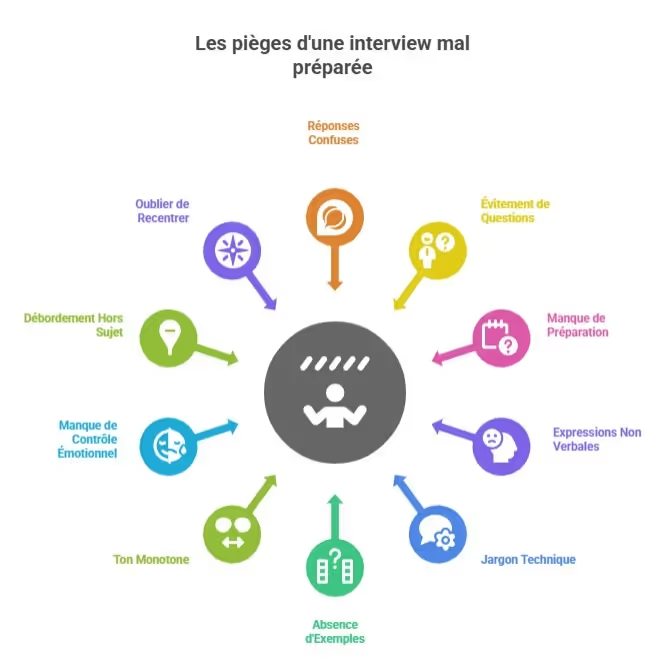
Concrete steps for preparing an executive for an interview
We often have this image of the charismatic executive, comfortable in front of the media, capable of responding off the cuff with a knack for the perfect soundbite.
But the reality is often different: the majority of successful public appearances are the result of methodical and strategic preparation.
- No, an executive is not naturally "good" at interviews.
- Yes, what we perceive as spontaneity is often the result of precise, structured, and sometimes meticulously timed training.
Behind the scenes, hours of work with communications experts, media training consultants, and monitoring teams go into preparing for every public appearance. It is the professional routine of high-profile executives.
Be careful: this preparation should not come at the expense of a certain spontaneity, provided it is controlled. An overly sanitized speech also has a negative effect.
Here are the 6 essential steps to prepare like a pro.
Identify the stakes, risks, and opportunities of the interview
Meeting room. Around the table: the executive, their communications director, and a media trainer.
Objective: understand the playing field.
"Who is the journalist? What is their editorial line? What is the audience's mindset?
Is this an ambush? An opportunity to correct perceptions? An exercise in transparency?"
- The journalist has a reputation for tough interviews.
- The subject is sensitive internally (social transformation plan).
- But... it is also a chance to set a clear course.
Develop the key messages to convey
In your office, accompanied by your coach.
You don't go to an interview just to answer questions.
You go there to convey a message, share a vision, and build support.
What you are building:
Anticipate sensitive questions and potential angles of attack
Let's move on to the blacklist.
“You talk about transformation, but isn't that just a coded way of saying you're laying people off?”
This is one of the ten “trap” questions you prepare for. But instead of dodging, you learn to deflect with elegance, to reframe, and to refocus on your goals.
You test phrases like:
“I understand the perception. But what matters are the facts: we are reinvesting in three key regions.”
“I take this question seriously. And I am answering you with full accountability.”
The goal isn't to say everything, but to master everything. Your coach teaches you the art of the strategic pivot.
Training in real-world conditions with a media trainer
Simulation studio. Camera pointed at you. You’re wearing your jacket, lapel mic attached. The lights are hot. The mock journalist attacks. You respond.
Formats tested:
- Radio interview: “Answer in 30 seconds, no more.”
- TV set: “Look at the camera. Don’t touch your tie.”
- Print media: “Provide quotes that are ready to be picked up.”
Your coach analyzes every posture, every word, every silence. They play the video back for you.
“Look: here, you shy away from the camera when you talk about your teams. There, you tense up during the follow-up.”
“And there, you really own your message: it’s powerful. That’s what we want to amplify.”
Refining posture, voice, and non-verbal communication
Session onphysical grounding. You stand, breathing deeply, while a vocal coach has you repeat key phrases, modulating your voice. A few typical exercises:
Debriefing to correct and adjust before the big day
Final meeting:
Final advice from the coach:
“Don’t get bogged down in operational details. Stay at your level of authority.”
“Always handle the closing yourself. Never let the follow-up questions dictate the end.”
Media training: a key lever for executives
On paper, mastering your interviews and asserting your leadership in front of the media seems natural, almost obvious.
But in real life, facing a composed journalist, under the pressure of cameras, without preparation, it can quickly become a nightmare. That is where media training comes into play.
It is not just another training course; it is a true training ground where the executive rehearses, adjusts, and confronts situations close to reality. It is this demanding work that allows you to transform an imperfect speech into a confident statement, and a hesitant posture into natural authority.
We explain how this key lever changes everything—not just in theory, but in the concrete impact you will have when facing the media.
Tailor-made training, designed for high-profile individuals
Every executive knows that their words are never trivial. Behind every interview lies an immense responsibility: that of representing their company, its values, and its vision.
Every word is carefully weighed, and your presence must always project authority and credibility. That is why media training never offers generic solutions.
Together, we build a personalized program, incorporating sensitive messaging, realistic scenarios, and, most importantly, the unique context in which the executive operates.
A proven method: immersion, repetition, and debriefing
The secret is to practice again and again.
Filmed simulations and role-playing exercises with mock journalists push the executive to step out of their comfort zone.
Then comes the debriefing, where we scrutinize everything: posture, tone, expressions—and yes, even that little hand tic that makes the coach raise an eyebrow. This is where confidence is built, step by step, and where your message becomes crystal clear.
In-depth coaching on communicative leadership
Beyond interview techniques, media training develops presence, assertiveness, and the ability to deliver a consistent message that inspires trust, whether in times of crisis or growth.
Because speaking isn't just about opening your mouth and hoping for the best.
What media training actually changes (before / after)
Our media training programs for executives
Discover our formats specifically designed for executives, featuring tailored paths and high-stakes simulations.
Each program is fully customized, designed to meet your specific goals, your industry, and your leadership style. You benefit from bespoke support, combining expert advice with innovative tools.
At the heart of our training: high-stakes simulations inspired by real-world cases and scenarios that mirror your daily challenges.
Whether you need to handle a delicate press conference, respond to a media crisis, or convince a board of directors, you will be prepared to speak with confidence and impact.
Through these immersive simulations, you will develop not only your presence but also your ability to react with agility and relevance to the toughest questions. All this in a safe and supportive environment, where every mistake becomes an opportunity to learn.
Experience media training that goes far beyond mere theory : a true training ground for demanding leaders who want to turn their communication into a powerful lever for credibility and influence.

Mathieu Pimort


Have questions?

Other resources LinkedIn & Media Relations

%20Large.avif)
Go from invisible to essential in your market
Your expertise deserves to be visible, credible, and shared, both on LinkedIn and in the media.


LinkedIn communication and Public Relations agency in Paris.
