

How to improve your media presence: common mistakes, techniques, and solutions

Article summary
- Media appearances are a strategic lever : every interview impacts your credibility and your company's image.
- Key techniques : delivering a strong idea in seconds, mastering your image and avoiding pitfalls, and respecting the verbal and non-verbal codes of each media format.
- The method : message, structure, illustration, voice, and posture. Media training turns an interview into a tool for influence, tailored to each format (TV, radio, social media, print).
Today, knowing how to speak in public is no longer enough. You must master the art of public speaking in a clear and convincing way, knowing how to deliver your message on camera, live, or in a podcast, with self-confidence, polished delivery, and above all… without nerves or stress.
Whether you are looking to win over an investor, engage your employees, or reassure an ecosystem in crisis, your media performance cannot be improvised. Working on your public speaking techniques, your pronunciation, your pacing, and your eye contact are essential for success. In 30 seconds, your choice of words, body language, and non-verbal communication send a powerful signal.
So, how can you avoid missteps and maximize your impact? At Linker, we give you the keys—the ones that turn a simple interview into a strategic asset.
Why media appearances have become a strategic lever
Media appearances are no longer just a "bonus": they have become a strategic lever that is essential.
Every public appearance impacts your reputation. It can lend credibility to your message… or erode trust. Speaking out means asserting a position, embodying a vision, and shaping the perception of your organization for the long term.
Whether on camera, on a podcast, or during a LinkedIn Live, you are both your own media outlet and your own ambassador. Mastering the rules of this exercise is no longer just an asset; it is a necessity for any professional seeking impact and legitimacy.
A high-impact public showcase for your image
Your public voice is your most visible—and often most decisive—business card.
Despite a notable climate of distrust toward traditional media in France, public speaking, particularly through alternative and well-mastered formats, remains an essential strategic lever. According to the’Edelman Trust Barometer 2024, 68% of consumers globally state that leadership communication influences their trust in a brand.
This reality highlights the importance of clear and authentic communication to build or restore credibility.
Increasing exposure: interviews, panel discussions, podcasts, LinkedIn Live…
Public speaking is no longer what it used to be. Gone are the days when an expert could settle for a calm radio interview. Today, they must juggle TV appearances, highly specialized podcasts, LinkedIn Live sessions in front of thousands of viewers, and even quick-hit videos on TikTok.
Imagine a leader of a tech scale-up : one day she establishes herself in a niche media outlet to prove her technical expertise, the next she explains the social impact of her innovation on a mainstream podcast, before following up with LinkedIn Live sessions to engage her B2B community.
But be careful, every format has its own rules. On social media, it needs to be lively, punchy, and fast-paced. On TV, rigor and preparation are what count.
In podcasts, authenticity and storytelling make the difference. Failing to adapt is a recipe for a flop, a loss of impact, or even a hit to your credibility.
Who is media training for?
Executives, startup founders, elected officials, industry experts, HR professionals, and influencers: everyone can benefit.
Whether you are an executive under pressure, an expert looking to become a thought leader, or an influencer seeking greater impact, media training has become an essential skill for any public-facing role, regardless of your sector or the size of your organization.
The specifics of speaking to the media
In the media arena, every second counts.
Whether on television, radio, or social media, you have very little time to convince your audience, make an impression, and deliver a clear message.
Mastering this skill is not only about knowing what to say, but also how to say it, while managing your image and the many pitfalls that lie in wait. This section details the keys to optimizing your public speaking and avoiding missteps.
Get straight to the point: a strong idea in a few seconds
Airtime is a rare and precious commodity: often less than 30 seconds to capture your audience's attention.
In that amount of time, there is no need to drown your message in an avalanche of information. The key is toidentify one strong idea, simple and impactful, which you will illustrate with a concrete example before concluding with a clear call to action.
Example: "AI can save healthcare workers time – but without governance, it puts professional ethics at risk."
This sentence summarizes an observation, adds nuance, and invites reflection or action.
According to a Nielsen study (2022), the average attention span of a viewer on an online video is 47 seconds. This figure highlights the urgent need to capture attention quickly.
Key takeaways:
- One strong idea
- One clear example
- One sharp call to action
Master your image and avoid missteps
Speaking to the media also means knowing how to handle the unexpected.
A trick question, selective editing, or a clumsy answer can quickly distort your message and damage your credibility. Preparation is your best weapon : knowing the classic pitfalls allows you to anticipate them and respond with confidence.
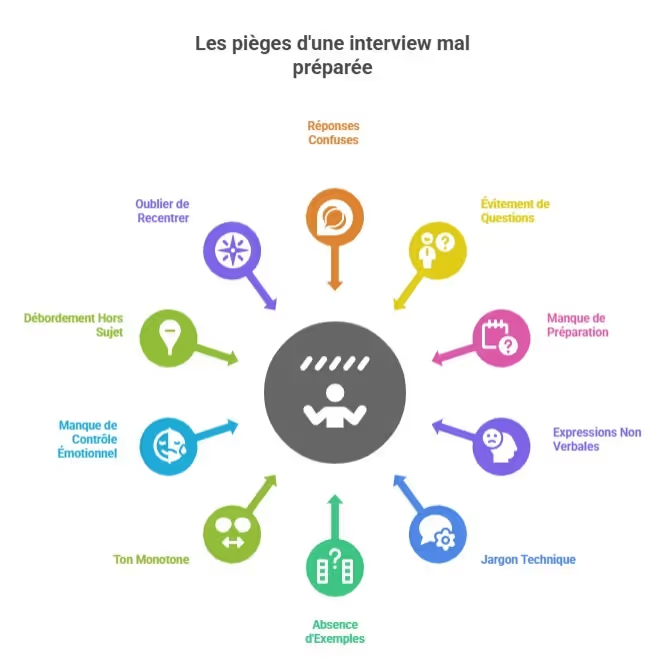
Learning to avoid these mistakes helps protect your image and strengthen your message.
Respect the verbal and non-verbal codes of the media
Communication is not limited to words. In front of a camera or microphone, your posture, eye contact, tone of voice, and pace play a decisive role in how the audience perceives you.
Using the right gesturesand avoiding nervous tics or closed-off body language also communicates confidence and credibility.
For example:
- Look at the camera, not your notes
- Maintain an open and stable posture
- Modulate your voice to keep the audience engaged
- Keep a natural pace without rushing
By mastering these codes, you turn every interaction into an impactful and professional moment.
Case study: Théo LION (Coudac)
Théo LION, co-founder and public face of Coudac, is a prime example of a new-generation tech speaker who has mastered the art of media appearances while maintaining a direct and uninhibited style.
Here is a breakdown of his communication style:
The most common mistakes… and how to fix them
People aren't listening to you. Why?
Because behind the apparent ease, there is often a lack of preparation. It’s not a question of talent. Or even stress. The real trap is improvisation disguised as spontaneity.
Too long, too vague, too “spontaneous”: you lose your audience before you’ve even begun.
You’ve started speaking… but no one is really listening. Because you’re improvising. And when you improvise without preparation, you lose your way.
You stumble, get bogged down in details, and throw out empty phrases. Worse: you think your delivery sounds “natural”… when it actually comes across as confused, hesitant, and sometimes pretentious.
The real danger isn’t stress. It’s poorly structured improvisation.
Speaking off the cuff might create the illusion of authenticity, but it mostly betrays a lack of clarity and control. The audience tunes out. And a missed media opportunity quickly becomes a reputational risk.
How to stay impactful:
- Prepare one strong idea: clear, concise, and memorable. A sentence the audience will remember even 10 minutes after the show.
- Practice out loud: to adjust your pace, steady your voice, and identify filler words (“um,” “like,” “you know”).
- Work on controlled spontaneity : ease doesn’t come from improvising, it comes from repetition.
It’s not about “playing a role”—it’s about speaking naturally because you know your subject inside and out.
Speaking without a plan is speaking into the void: never lose sight of your goal.
Every time you speak, you have the opportunity to influence how you are perceived. But if you don't know what you want to provoke in your audience, your message will miss the mark. What is the point of being brilliant if no one understands why you are speaking?
Before every presentation, ask yourself 3 simple questions:
- What is my goal? (to inform, reassure, convince, or engage?)
- What is the main message I want to convey?
- What impression do I want to leave behind? (expertise, leadership, innovation, or approachability?)
"I'm going to let you in on a secret." This phrase, used by politicians during interviews, drives me crazy. Everything is calculated, right down to their gestures. How dare they use a word that implies a sense of spontaneity?
Rachida Brakni, in “Le Monde” in 2017
Book an appointment with the team
Preparing for media appearances: a 5-step method
A poorly prepared message is a missed opportunity — or worse, a PR disaster. Whether you are on the radio, television, or live on LinkedIn, it is not just about "talking": it is about convincing, making an impression, and strengthening your credibility.
The good news? Impact can be prepared. And it often comes down to 5 essential levers : message, structure, illustration, voice, and posture.
To turn a simple interview into a standout moment, here is the method to follow, clear, practical… and pro-tested.
Media training: your best asset for shining in front of the media
If you want to master your nerves, captivate your audience, and be persuasive on air, media training is THE key.
Media training: what is it?
Media training is much more than just a training session — it’s a tailor-made experience, designed to prepare you to shine in front of the media. At Linker, we don’t do empty theory: you experience the reality of the field.
More than just preparation, media training is a true accelerator for confidence and impact. You learn to master the specific codes of journalists, structure a compelling message, and handle any situation, even the most unexpected ones.
It allows you to acquire solid instincts, practice for different media formats (TV, radio, and print interviews), and test various approaches, both vocal and physical.
What does a typical session at Linker look like?
- Media decoding : understand what journalists are really looking for and how to grab their attention from the very first seconds.
- Immersive simulations : filmed interviews in real-world conditions, where you take the lead role, facing questions that can sometimes be unsettling.
- Precise and actionable debriefing : viewing, detailed analysis, personalized advice, and a clear action plan for immediate improvement.
Every step is designed to make you more confident, more natural, and above all, more effective when you speak.
Why choose Linker for your training?
Preparing for media appearances cannot be improvised. To master the specific codes of each medium and gain confidence, there is no substitute for professional guidance.
Media training with an agency like Linker provides you with:
- An expert and objective perspective, which reveals your strengths and areas for improvement that you might not see yourself.
- Concrete immersion in real-life interview situations, through filmed role-playing and precise debriefings.
- Rapid and lasting progress, by developing your reflexes, posture, voice, and storytelling tailored to each format
Whether you are an executive, spokesperson, or expert, media training is the secret weapon to transform your communication, strengthen your credibility, and deliver your messages with impact.
With Linker, reveal the best version of yourself in front of the media
Book an appointment with the team
Bonus: formats to master depending on the media
Every medium has its own codes, requirements, and pitfalls to avoid.
Whether it is television, radio, social media, or conferences, the secret to successful communication lies in the ability to adapt your message and posture to the format.
To maximize your impact, it is essential to understand these specificities and practice best practices, so you can convey your message clearly, authentically, and professionally.
Common mistakes, such as poorly managed improvisation or a lack of structure, can quickly damage your credibility and the impact of your speech.
Conversely, by applying proven techniques – choosing a strong idea, clear articulation, open posture, stress management – you turn every presentation into a powerful strategic lever.
Whether you need to reassure, persuade, charm, or engage, your public speaking is now a genuine tool for influence and leadership. Investing in tailored training, practicing methodically, and learning to manage your image in front of the media will help you gain confidence, avoid pitfalls, and, above all, convey your message with strength and authenticity.
Ultimately, improving your public speaking is about giving yourself the means to capture attention, build trust, and make your vision resonate in a world where every word counts.

Mathieu Pimort


Have questions?

Other resources LinkedIn & Media Relations

%20Large.avif)
Go from invisible to essential in your market
Your expertise deserves to be visible, credible, and shared, both on LinkedIn and in the media.

LinkedIn communication and Public Relations agency in Paris.
