

Leader Advocacy: what if your executives became your company's primary ambassadors?

Article summary
- Leader advocacy transforms leaders into ambassadors : on LinkedIn, a post from a leader generates far more interaction and trust than a company page.
- It's not just for the CEO : executive committee members and subject matter experts can also be the voice of the company, provided they have credibility and a sincere approach.
- The keys to success : a unique voice, a consistent editorial line, a steady rhythm, coordination with communications, and precise performance measurement. People follow people before they follow brands.
You invest in your employer brand, your corporate communication strategy, your press relations… but your messages aren't reaching their target on professional social networks like LinkedIn?
You post regularly on your channels, you refine your talking points, you share your CSR commitments and your company's official stances… Yet, the audience remains passive, interactions are limited, and the impact is difficult to measure, despite the real potential for organic visibility and the influence of your executives.
What if the problem isn't the message, but the person delivering it?
Today, one truth is clear: individuals have more influence than institutions, especially when they speak in a personal capacity. On LinkedIn, a post published by an engaged executive generates up to 5 times more engagement than content shared by a company page.
Executive communication inspires more trust. It embodies the vision, creates connections, strengthens the brand image, and develops the organization's strategic influence.
We explain why and how to make Leader Advocacy an essential lever for performance, rather than just a trend, a mere stylistic exercise, or an opportunistic personal branding tactic.
What is Leader Advocacy? (And why is everyone talking about it?)
Leader advocacy refers to a structured approach in which executives, board members, or key experts speak out on their social media channels (often LinkedIn) in their own name to share their vision, their convictions, and embody the brand in a personal and authentic way.
In the face of advertising and corporate content, the voice of leadership makes all the difference: more human, more direct, and more engaging.
It is not just about "occupying space" on LinkedIn or Twitter. It is about activating a content strategy that is embodied, aligned with your business goals, your communication priorities, and the expectations of your internal and external audiences.
A voice that strengthens your brand positioning, builds executive visibility, and fuels a coherent influence strategy.
Why are companies increasingly betting on their leaders?
Because People listen to people, not logos. And above all, they listen to people they perceive as credible, relatable, inspiring, and driven by strong values.
In a marketing and media landscape saturated with standardized corporate content, companies have realized that their executives, board members, or internal experts can become the best ambassadors for their brand, particularly on platforms like LinkedIn, where the algorithm prioritizes personal profiles and fosters connections between leaders and their network.
A different kind of communication, featuring sources who aren't influencers, but rather individuals with a track record, hands-on experience, and genuine expertise, who choose to amplify their company’s voice in the market.
3 immediate effects observed in our clients when executive voice becomes a strategy
Their messages take off.
Their LinkedIn posts no longer get 12 likes. They generate 100, 200, sometimes 1,000 reactions.
Why? Because a leader who speaks with sincerity, in a direct and authentic tone, captures attention better than any corporate page. These are new opportunities to defend reputation and champion essential topics.
Their ecosystem listens (really listens).
Clients, partners, journalists, investors… They all listen when the message comes from the top. The result: greater credibility, more press coverage, and stronger business connections.
The company no longer just "communicates," it inspires, building social bonds and strengthening its ability to unite both long-standing and new stakeholders.
Top talent comes knocking.
A recent graduate who discovers a company through its CEO’s post is more likely to apply than through a standard job board listing.
Leadership voices set a course, define a vision, and inspire others to follow, thereby strengthening the employer brand and internal alignment. New talent joins to champion a cause, effectively becoming the best possible influencers for their leadership team.
What are the concrete effects of a leader advocacy strategy compared to corporate social media communication:
Leaders are no longer just the guardians of strategy. They can become media outlets in their own right. And with the right support, they become powerful levers for influence, visibility, and impact.
Who should be involved in a leader advocacy program?
We naturally think of the CEO or the president… but influential communication is not limited to top management.
The strength of leader advocacy lies in mobilizing several complementary faces that embody the company's vision, strategy, and expertise all at once.
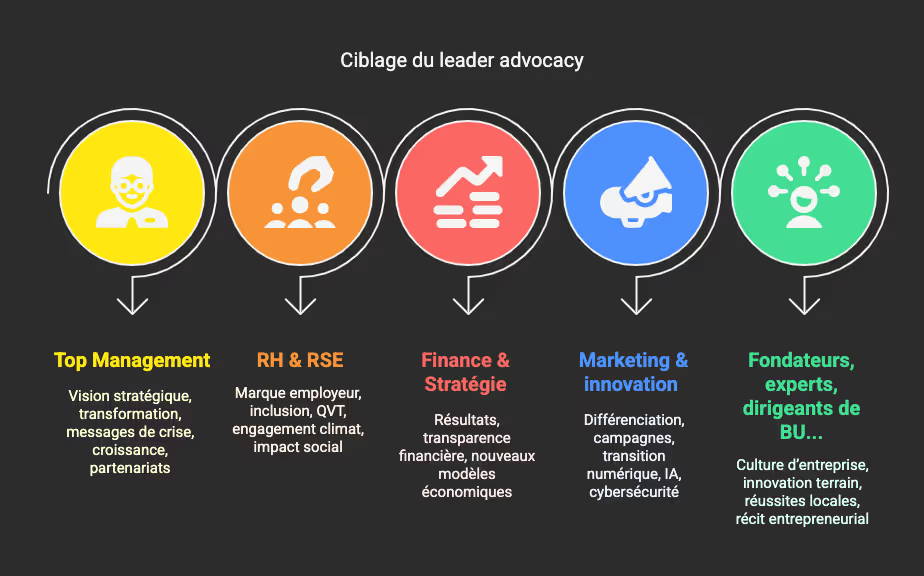
What makes the difference isn't just the job title, but:
- the legitimacy of the message,
- the sincerity of the approach,
- and the alignment with the organization's values and goals.
The most impactful profiles are not always the most visible at first. A subject matter expert who is not used to speaking out can become, with the right support, a credible, human, and distinctive voice for the brand.
Identifying and selecting the right internal ambassadors is often the starting point for an effective leader advocacy strategy. This is where the guidance of a specialized agency can make all the difference.
Which topics and content work best for a leader advocacy strategy?
These are not just “any” posts
An op-ed, like a great leader post:
- embodies an opinion or vision,
- draws oncurrent events or lived experience,
- offers a personal perspective on a professional or societal issue,
- or highlights teams and projects with authenticity.
Rather than a long explanation, here are a few post examples to illustrate:
Every leader has their own favorite topics. The challenge lies in analyzing and then orchestrating both individual and collective editorial lines. This is where expert guidance becomes strategic.
Inspiring examples and resources to go further
Here are some examples of influential leaders on LinkedIn and Twitter:
LinkedIn:
- Olivier Mathiot, co-founder of PriceMinister and president of France Digitale. He regularly shares insights on entrepreneurship, innovation, and digital transformation.
- Delphine Rémy-Boutang, CEO of Join Forces & Dare. She publishes advice and shares experiences for other leaders.
- Frédéric Mazzella founder of BlaBlaCar. He uses his platform to promote entrepreneurship and the positive impact of businesses.
Twitter:
- Xavier Niel, founder of Iliad (Free). He shares his views on economic and technological news in a committed and sometimes provocative way.
- Roxanne Varza, director of Station F. She shares insights on the French and European startup ecosystem.
- Jean-David Chamboredon, president of ISAI. He comments on venture capital and innovation news.
Key success factors (pitfalls to avoid) and KPIs.
An effective leader advocacy program is therefore built on several pillars:
- A clear and distinctive stance for each executive
- Astructured editorial line , consistent with the overall strategy
- A consistent and realistic posting schedule
- Close coordination with the communications and HR teams
- A precise measurement of performance (reach, engagement, reputation)
To measure the efficiency of your strategy, here are the KPIs to monitor when evaluating the performance of executive communications:
How can you support executives in their communications?
Speaking out as an executive (or expert employee) is about more than just posting on LinkedIn. It’s about putting yourself out there, embodying a vision, and delivering and developing a message that resonates. And that inevitably raises some concerns.
The hesitations are very real (and legitimate)
“I don’t have the time.”
“I don’t know what to say.”
“I’m not comfortable with LinkedIn’s conventions.”
I don’t want to do what everyone else is doing.
We hear these objections every day. And they are logical and legitimate. Behind them often lie questions regarding positioning, legitimacy, clarity, and the role of the leader in communication.
Or quite simply, they are generated by a lack of resources to structure this communication over the long term.
A progressive, bespoke approach
At Linker, we know there is no magic formula. Every leader has their own personality, style, time constraints, and preferred topics.
That is why we build tailor-made programs, co-created with communication, marketing, or HR teams and based on our own experience, to meet your specific needs.
Our support is based on 5 concrete pillars:
1. Identifying the right profiles to activate
Not all leaders are meant to communicate in the same way. We start by mapping high-potential profiles, in line with the company’s business, HR, or reputational goals.
2. Define a unique editorial line
Speaking out is important, but not just to "make noise." Every leader benefits from a personalized editorial strategy : key themes, differentiating angles, and a tone tailored to their personality.
3. Co-create or ghostwrite content
We work hand in hand with each individual to create content that reflects who they are. Some prefer to be guided verbally, while others prefer to review written drafts. Our goal: to make their voice heard, while staying true to them.
4. Provide support for public speaking (written, video, live)
We prepare them for all forms of expression: writing posts, filming short-form video content, or speaking at events and interviews. We also manage comments and interactions to avoid PR crises or burnout.
5. Manage and adjust the strategy
We measure what works, we analyze the feedback, we adjust the pace, formats, and messaging. Then, we amplify high-performing content using organic or paid strategies.
Going further: a diagnostic before taking action
Do you feel your executives have something to say, but aren't sure how to get the momentum going ? Have you tried isolated posts without lasting success? Or are you looking to move from one-off initiatives to a true influence strategy driven by your leaders?
We offer a personalized diagnostic to assess your potential, identify the right levers, and map out the next steps together.

Mathieu Pimort


Have questions?

Other resources LinkedIn & Media Relations

%20Large.avif)

Go from invisible to essential in your market
Your expertise deserves to be visible, credible, and shared, both on LinkedIn and in the media.

LinkedIn communication and Public Relations agency in Paris.
