

2026 LinkedIn Guide: How to stay visible in an AI-driven feed
Article summary
- LinkedIn reach collapsed in 2025 (down about 60%): this is not a creator problem but a structural change to the feed, now driven by AI (the 360Brew model).
- The algorithm interprets your positioning : it values expertise, long-term consistency, and genuine conversations, not volume or generic content.
- Being visible is no longer enough; you must be identified : clear positioning, 2-3 editorial pillars, and regularity. In 2026, the winning equation is consistency + constancy + quality.
Just two or three years ago, LinkedIn was a real opportunity.
On many topics, there wasn't much competition. Posting regularly, even without a highly advanced strategy, was enough to get noticed.
Today, the situation is very different.
LinkedIn is saturated. There are many more users, much more content, and above all, a lot of content that all looks the same. AI has made creation easier and faster… but also much more uniform.
The result: posting has never been easier.
But achieving lasting visibility has never been more complicated.
And more importantly, one key point is often misunderstood: visibility no longer means much if it isn't backed by authority.
This guide has a simple goal: to explain where LinkedIn really stands at the end of 2025, what the platform now values, and how executives can adapt their strategy for 2026 without burning out.
What has really changed in recent months
Since the beginning of 2025, many have had the same impression:
“I’m posting as much as before, sometimes even better… but it’s just not gaining traction.”
It’s not just an impression.
It’s a fact.
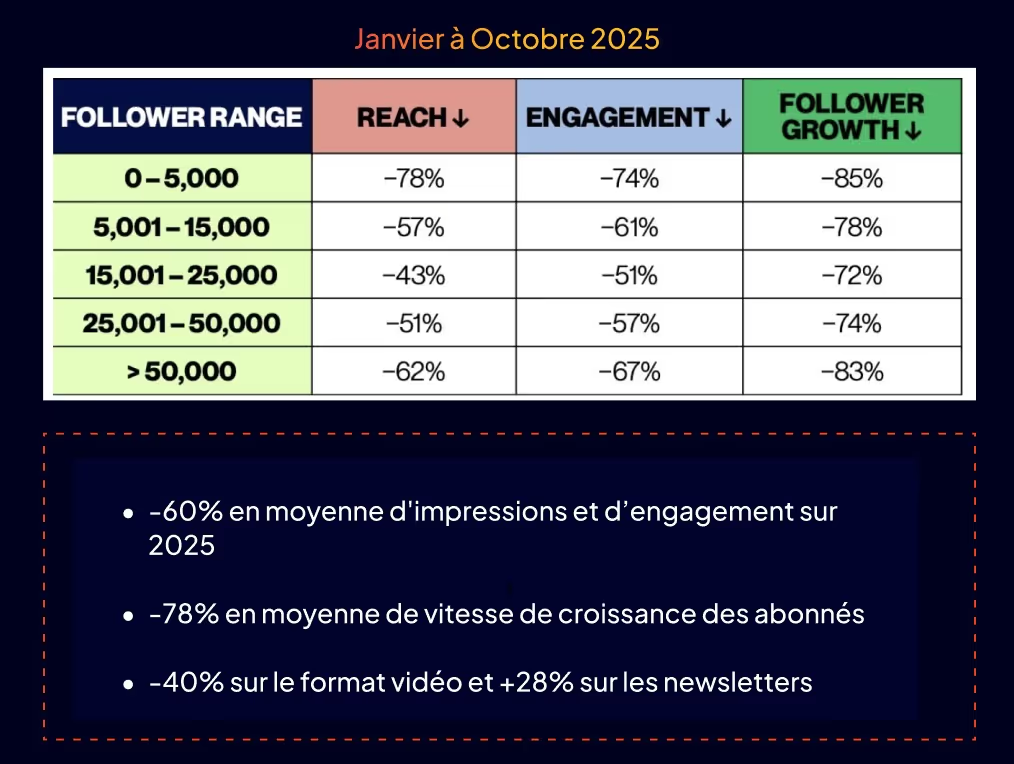
Richard van der Blom analyzed nearly 400,000 profiles, 200,000 pages, and 600,000 pieces of content over ten months. And the numbers are clear: between January and October 2025, average visibility on LinkedIn plummeted.
Reach and engagement dropped by about 60%, follower growth by nearly 80%, and video took a real hit.
This isn’t a creator problem.
It’s a structural change to the feed.
Why?
Because LinkedIn no longer just “scans” your posts. It readsthem.
LinkedIn now interprets the meaning of what you publish
With the arrival of its internal model, 360Brew, LinkedIn has reached a turning point.
The algorithm no longer just identifies keywords or formats. It interprets your content as semantic signals. Simply put, it seeks to understand:
- what you are actually talking about
- which topics you have authority on
- whether your contributions are consistent over time
- whether your tone and themes are stable
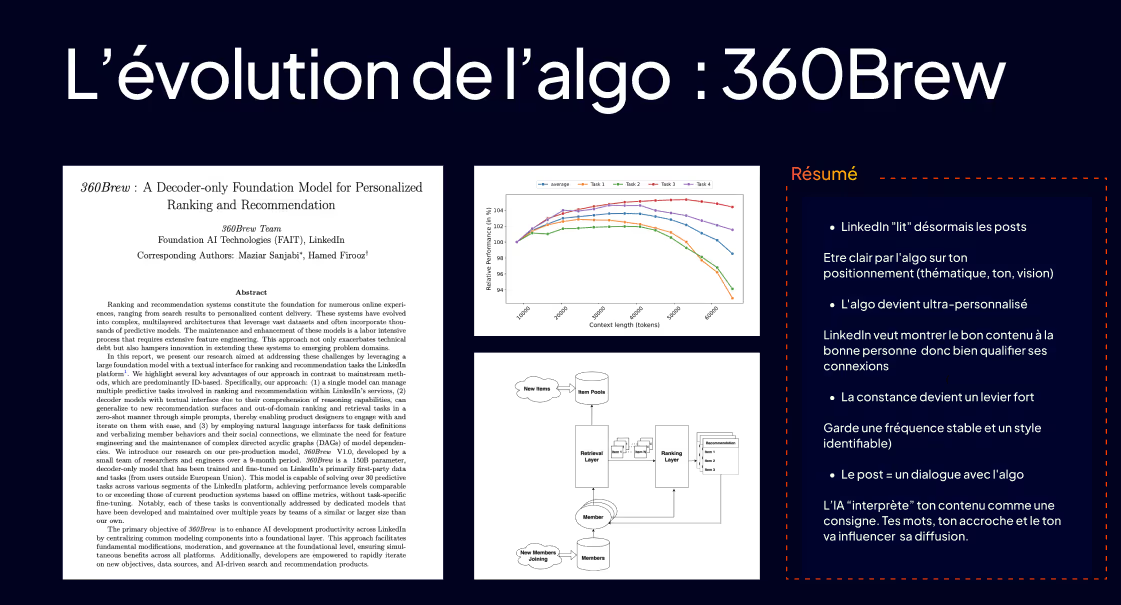
In other words, LinkedIn no longer just ranks your posts.
It interprets your positioning.
And when that positioning is vague, unstable, or overly opportunistic, reach drops. Regardless of the "technical" quality of the post.
This is exactly what explains the widespread decline in 2025: no one is spared, regardless of your follower count.
The end of generic content (and why that’s good news)
AI has fundamentally changed content creation. It helps you move faster, structure ideas, and save time. At Linker, we use it too.
But one thing is clear:
posts that are too polished, too clean, and too generic are performing worse and worse.
Why?
Because when everyone uses the same tools in the same way, everything ends up looking the same.
LinkedIn now seems to penalize this interchangeable content. Not because it’s “bad,” but because it doesn’t help the algorithm understand who you are and what you’re an authority on.
The rule is now very clear:
AI as a tool, yes. AI as an author, no.
AI supports the thinking process.
It does not replace your voice, your experience, or your personal journey.
Expertise comes before visibility
Another major shift is emerging for 2026: LinkedIn is increasingly valuing depth, not volume.
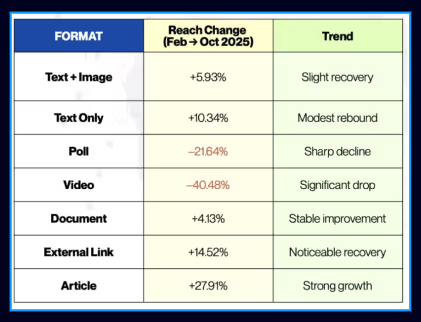
The data shows it very clearly:
- editorial formats are growing (plain text, documents, articles)
- heavy visual formats are declining
- newsletters are booming (+28% in 2025)
What LinkedIn is looking to highlight is content that truly helps people understand: tutorials, analyses, frameworks, and real-world feedback.
Fewer punchlines.
More education.
LinkedIn does not want to become a network of influencers. On the contrary, it is strengthening its positioning between a social network and a professional media outlet.
Conversations are becoming the real KPI
A like doesn't mean much anymore.
Neither does a hollow comment.
What LinkedIn now values are genuine interactions :
- thoughtful comments
- author responses
- ongoing discussions
Posts have become a dialogue with the algorithm.
And that dialogue relies on the clarity, consistency, and readability of your positioning.
What AI cannot replace are real human interactions centered on concrete business topics. And LinkedIn knows this very well.
Executive personal branding is becoming central
Another very strong signal: company pages are plateauing.
Personal profiles, on the other hand, continue to stand out.
Why?
Because LinkedIn values identifiable voices.
An executive who speaks consistently on a few well-defined topics becomes a go-to resource in the feed. And that is exactly what the algorithm seeks to understand and amplify.
By 2026, personal branding is no longer just a "nice to have."
It is a genuine driver of business influence.
Video, carousels, and long-form text: the winning trio
Contrary to popular belief, LinkedIn does not favor a single format.
What works best today are formats that help people understand :
- carousels, diagrams, infographics
- photos + text
- newsletters
- long, structured text posts
Video remains useful, especially face-to-camera, for building trust. But it is no longer enough on its own.
The common thread among all high-performing formats?
They clarify, structure, and increase the time spent on the content.
Why visibility is no longer enough
Posting frequently doesn't mean much anymore.
What matters is being identified.
This is where the difference lies:
- posting often → hit-or-miss visibility
- being identified → lasting authority
In 2026, personal branding relies on:
- clear positioning
- recurring themes
- messages repeated from different angles
- real, authentic experience
This consistency is what allows the algorithm to “read” you correctly.
Getting started (or restarting) on LinkedIn in 2026: the basics
Your LinkedIn profile as a landing page
Your profile must clearly state:
- who you help
- with what
- and why you are credible
Headline, banner, "About" section: everything must be aligned.
A real content strategy
Posting without a goal is a recipe for burnout.
In 2026, an effective strategy relies on:
- clear objectives
- a well-defined target audience
- a maximum of 2 to 3 content pillars
- a consistent narrative thread
Rhythm and consistency
LinkedIn now recommends 10 to 20 posts per month.
But the key isn't intensity. It's consistency.
It is better to maintain a steady pace over 8 to 12 weeks than to post heavily for a month and then disappear.
Working solo, getting coaching, or outsourcing?
Working alone can work if:
- the strategy is clear
- you have the time
- writing comes easily
- and you have the discipline
In reality, many executives struggle with the mental load, a lack of perspective, and the difficulty of maintaining consistency over time.
That is where professional support makes all the difference.
LinkedIn Coaching
Ideal if you want to write your own content, but with structure, a framework, and an outside perspective. Discover here what LinkedIn coaching includes and how it can enhance your executive communication.
LinkedIn Ghostwriting
Best when you are short on time, but speaking out remains a strategic priority. The ideas and vision remain yours; the execution is delegated. Discover here how a LinkedIn ghostwriter can lighten your daily workload.
To explore this choice further, read the article " Getting started on LinkedIn: write it yourself or delegate? » helps clear things up.
The bottom line: what LinkedIn will actually reward in 2026
LinkedIn will not reward:
- the loudest
- the most automated
- or those posting without a vision
It will reward:
the most coherent, the most consistent, and the most authentic.
In an AI-driven feed, the only long-term strategy is not volume.
It is the equation coherence + consistency + quality.
And that is exactly where the difference will be made in 2026.

Mathieu Pimort


Have questions?

Other resources LinkedIn & Media Relations
%20Large.avif)
Go from invisible to essential in your market
Your expertise deserves to be visible, credible, and shared, both on LinkedIn and in the media.

LinkedIn communication and Public Relations agency in Paris.
