

TOFU-MOFU-BOFU: The winning LinkedIn strategy

Article summary
- The TOFU-MOFU-BOFU method segments content based on the audience journey : TOFU for visibility, MOFU for credibility, BOFU for conversion.
- Adapt the distribution to your goal : 50/25/25 to gain visibility, 25/50/25 to strengthen your community, 25/25/50 to convert.
- In summary : TOFU = speak to everyone (visibility), MOFU = speak to your industry (community), BOFU = speak to your clients (conversion). Test, measure, adjust.
How can you turn your LinkedIn profile into an opportunity machine with the TOFU-MOFU-BOFU method?
The other day, while scrolling through my feed, I realized that those who really stand out on LinkedIn aren't just active; they have a real strategy behind every post.
Imagine for a moment: every piece of content you share brings you closer to your goals, positions you as an expert in your field, and creates genuine engagement with your audience. Sounds like a dream, right? And guess what? It’s entirely possible with the TOFU-MOFU-BOFU method. Let’s dive in!
Understanding the TOFU-MOFU-BOFU Method
So, what is this method with the funny name? Basically, it’s a way to segment your audience and your content into three crucial stages.
But before we dive into the heart of the matter, imagine a funnel. It’s wide at the top and narrows at the bottom. This funnel represents your audience's journey, from discovering your brand to the final purchase decision.
- TOFU: Top of the Funnel
Imagine you're hosting a big party. TOFU is like sending out an open invitation to everyone. You want to attract as many people as possible.
On LinkedIn, this translates to general, informative content that answers common questions or addresses trending topics.
The goal? To build brand awareness and grab attention.
- MOFU: Middle of the Funnel
Now, imagine you're at that party and you start chatting with the guests. You want to show them you're interesting and trustworthy, right? It’s the same on LinkedIn.
Here, you share more in-depth content, such as case studies, testimonials, or even webinars.
You build your credibility, showcase your expertise, and engage more deeply with your audience.
- BOFU: Bottom of the Funnel
The party is winding down, and you invite a few close friends to stay for one last drink. This is the moment of conversion. On LinkedIn, after building a solid relationship with your audience, you can start talking to them about your products or services.
But be careful—always be subtle. Offer demos, free trials, or consultations.
The goal? To convert these warm leads into loyal customers.
In short, this means structuring your topics to optimize your conversion funnel: from the most general (TOFU) to the more niche (MOFU), and finally to the ultra-specialized (BOFU).
Using the TOFU-MOFU-BOFU Method on LinkedIn
TOFU: Achieving Virality
We all know how much a viral post can have a huge impact on your visibility. But how do you get there? On LinkedIn, the key is to publish content that truly grabs attention.
Think of well-designed infographics that simplify complex concepts, captivating videos that tell a story, or inspiring anecdotes that resonate with your audience.
And don't forget to add a personal touch to every post. Ask a question, share an anecdote, or even a failure.
Authenticity is the secret to encouraging people to engage with and share your content.
=> Bonus at the end of the article: 4 strategies for creating viral LinkedIn posts
MOFU: Building Your Credibility
On LinkedIn, just being present isn't enough. You also need to prove that you are an expert in your field. How? By sharing your knowledge on a regular basis.
Write articles that address specific issues in your industry, join discussions, comment on relevant posts, and don't hesitate to share your own experiences.
Every interaction is an opportunity to show that you know your stuff and to strengthen your position as an authority in your field.
BOFU: Converting Your Ideal Clients
After attracting and engaging your audience, it’s time to take action.
But be careful—subtlety is key. Instead of taking an aggressive sales approach, offer solutions tailored to your audience's needs.
Perhaps a demo of your product, a free consultation, or a detailed ebook.
The idea is to provide value while gently guiding your audience toward a purchasing decision. And remember, on LinkedIn, trust is everything.
So, build that trust step by step, and the conversions will follow naturally.
Creating a tailored editorial line
Choosing your post topics based on your goals is crucial to maximizing the impact of your LinkedIn presence.
Whether you are looking to increase your visibility, strengthen your credibility, or convert prospects, the key is to adapt your content strategy to your current stage.
Aiming for visibility
If you find your reach is too low to generate opportunities, it’s time to focus on visibility. How? By aiming for a split of:
- 50% TOFU
- 25% MOFU
- 25% BOFU
This is a great strategy when you're just starting out and have between 0 and 10,000 followers.
Strengthening the community
If your reach is starting to look good but you feel the need to be recognized by your peers, it’s time to focus on your community. Opt for a split of:
- 25% TOFU
- 50% MOFU
- 25% BOFU
This is the strategy to follow once you’ve hit 10k followers but have hit a plateau.
Focusing on conversion
If you already have good visibility and your main challenge is credibility, then focus on conversion. How? With a split of:
- 25% TOFU
- 25% MOFU
- 50% BOFU
Not sure where you stand? : If you’re feeling a bit lost and don’t know where to start, don’t panic! Go with a balanced split of +/- 33% pour chaque segment : TOFU, MOFU et BOFU.
Peu importe que tu publies 4, 10, 24 ou 50 posts par mois, cette stratégie est adaptable à chaque situation.
Et avec le temps, tu pourras ajuster en fonction de tes résultats et de tes objectifs.
Établir votre propre matrice de contenu
Lorsqu’il s’agit de créer une stratégie de contenu sur LinkedIn, il est essentiel d’avoir une vision claire de ce que tu veux partager et comment tu veux le faire. C’est là qu’intervient la matrice de contenu.
Elle te permet de structurer, d’organiser et de planifier ton contenu de manière efficace.
Les Sujets Clés de Ta Ligne Éditoriale
Avant de te lancer tête baissée dans la création de contenu, prends un moment pour réfléchir aux sujets qui te tiennent à cœur et qui sont pertinents pour ton audience.
Pose-toi la question : quels sont les 3 à 5 sujets principaux que tu souhaites aborder sur LinkedIn ?
Ces sujets peuvent être liés à ton domaine d’expertise, aux tendances actuelles de ton secteur ou à des thématiques qui te passionnent.
L’important est qu’ils résonnent avec ton audience et qu’ils te permettent de te positionner comme une référence dans ton domaine.
Subdiviser dans la Matrice TOFU-MOFU-BOFU
Une fois que tu as défini tes sujets clés, il est temps de les intégrer dans la fameuse matrice TOFU-MOFU-BOFU. Comment ? En associant chaque sujet à l’une des trois étapes de l’entonnoir.
- Pour les sujets destinés à augmenter ta visibilité et à attirer un large public, place-les dans la catégorie TOFU.
- Les sujets qui te permettent de renforcer ta crédibilité et d’engager davantage avec ton audience iront dans la catégorie MOFU.
- Enfin, les sujets qui ont pour objectif de convertir ton audience en clients ou partenaires seront classés dans la catégorie BOFU.
Diversifier votre Contenu
Dans le monde saturé des médias sociaux, se démarquer est plus crucial que jamais. Et sur LinkedIn, où chaque professionnel cherche à briller, la diversification de ton contenu est la clé pour te démarquer et laisser une empreinte mémorable.
Stratégie de Contenu Créatif
Alors, comment faire vibrer ton audience tout en restant professionnel ? La réponse est simple : en introduisant des sujets créatifs et différenciants.
Pense à des formats innovants, comme des vidéos animées, des infographies interactives ou même des quiz. Mais ne t’arrête pas là.
Partage des anecdotes personnelles, des histoires de réussite (ou d’échec !) et des moments marquants de ta carrière. Ces touches créatives non seulement renforcent ta marque personnelle, mais elles rendent aussi ton contenu plus humain et relatable.
Maintenir un Équilibre
Bien sûr, il est tentant de se laisser emporter par la vague créative et d’oublier ses sujets principaux. Mais attention, l’équilibre est essentiel.
Imagine ton contenu comme un repas équilibré : tes sujets principaux sont les protéines, les sujets créatifs sont les épices. Trop d’épices et le plat est gâché, pas assez et il est fade. Alors, comment trouver cet équilibre parfait ? En planifiant.
Définis à l’avance la fréquence de publication de chaque type de contenu. Et n’oublie pas de mesurer régulièrement l’impact de ton contenu pour ajuster ta stratégie en conséquence.
En diversifiant ton contenu tout en maintenant un équilibre, tu te positionnes non seulement comme un expert dans ton domaine, mais aussi comme une voix unique et authentique sur LinkedIn.
Le dé(brief)
On y est presque, la fin de notre exploration de la stratégie LinkedIn TOFU-MOFU-BOFU. Pour faire court, voici un petit récap :
- TOFU = parler à tout le monde = être visible = visibilité
- MOFU = parler à son secteur = engager = communauté
- BOFU = parler à ses clients = convertir = crédibilité
C’est assez simple, non ? Mais derrière cette simplicité se cache une stratégie puissante pour te positionner comme un leader sur LinkedIn.
Alors, avant de te lancer, garde à l’esprit que la clé est d’adapter et d’évoluer en fonction de tes résultats. Teste, mesure, ajuste, et surtout, profite du processus.
BONUS : 4 stratégies pour faire des posts viraux sur LinkedIn
1. Le post « personnel »
Un mélange de storytelling, de vulnérabilité et d’apprentissages.
Mets une photo de toi. L’effet est garanti.
Mais attention à l’audience que tu veux toucher.
Funnel : TOFU.

2. Le post « portrait »
C’est une stratégie qu’on a tous déjà testée, et je te confirme que c’est toujours aussi efficace.
Tu as deux options :
- raconter des anecdotes incroyables sur une personne peu connue
- partager des anecdotes que personne ne connaît sur une célébrité.
Choisis bien la photo.
Funnel : TOFU.

3. Le post « GROSSE annonce »
Ici, l’objectif est de créer un effet de surprise et de « waouh ».
- Un changement radical ?
- Un nouveau poste ?
- Une nouvelle aventure ?
- Des résultats business impressionnants ?
Ce post te permettra de parler de ton expertise ou de ton activité à ton réseau. Tous les formats sont bons.
Funnel : TOFU ou BOFU (selon le ton/angle).
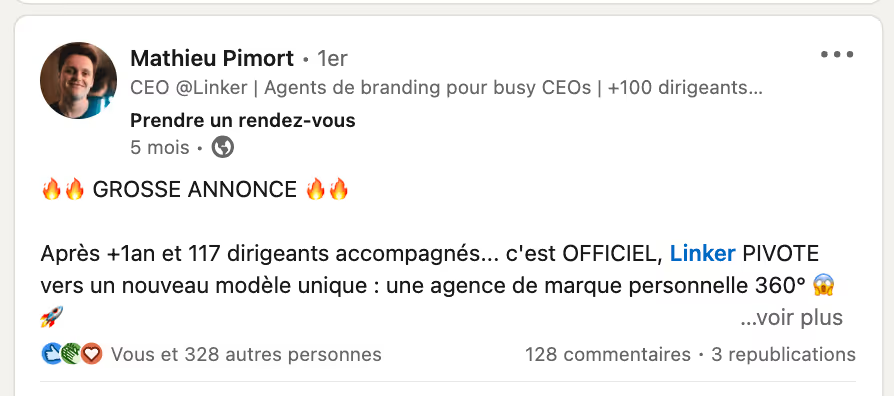
Exemples :
- « Je deviens DRH chez Linker » –> TOFU (photo)
- « Je me lance dans une nouvelle aventure professionnelle! » –> TOFU (écrit)
- « Linker se transforme en agent de marque à 360° » –> BOFU (écrit)
- « On lance notre formation sur Twitter! » –> BOFU (vidéo)
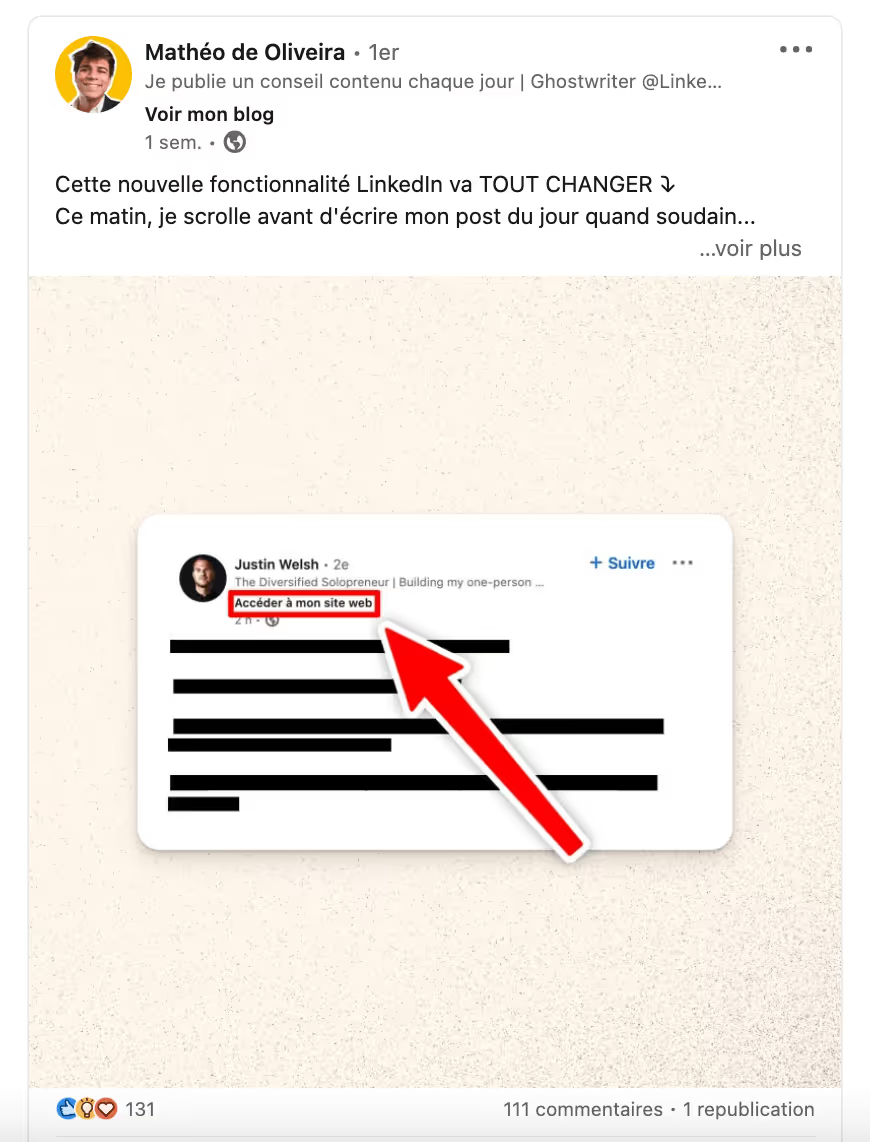
4. Le post « prise de position sur actu »
Ici, tu donnes ton avis sur une actualité. Le niveau du funnel dépendra de la spécificité de la news
- "3 new features for server-side tracking for Q4" –> BOFU
- "Twitter vs Threads: my analysis" –> MOFU
- "Store closures in Nîmes: let's find solutions" –> TOFU
You can do this in written format or as a photo if you share the article.

Mathieu Pimort


Have questions?

Other resources LinkedIn & Media Relations

%20Large.avif)

Go from invisible to essential in your market
Your expertise deserves to be visible, credible, and shared, both on LinkedIn and in the media.

LinkedIn communication and Public Relations agency in Paris.
