

Linker Guide: create LinkedIn content in 2026

Article summary
- In 2026, LinkedIn is a professional medium where depth and added value take precedence over raw frequency.
- The formats that perform : the carousel (star format for reading time), text posts, native video, newsletters, and employee-generated content.
- The algorithm prioritizes dwell time, high-quality conversations, and reach within your extended network. Relevance, the right format, early engagement, and consistency are the keys to performance.
Having a solid presence on LinkedIn is no longer just a "nice to have": it is a strategic necessity for anyone looking to increase their visibility on LinkedIn and build a personal brand that stands out.
By actively polishing your LinkedIn profile (profile picture, logo, bio, experience), sharing engaging content , and interacting with your target audience, you aren't just boosting your reputation in your professional life; you are also using LinkedIn as a growth lever for your business, your field of expertise, or your professional network.
Whether it's a text post, a video, a PDF carousel, or a LinkedIn newsletter, every type of content must offer added value to the reader, capture their attention, and foster human engagement. You will discover how to use LinkedIn as a strategic lever, build your personal brand, attract the attention of your professional network, and transform your LinkedIn posts into a powerful tool for digital marketing and social selling.
Understanding the 2026 LinkedIn ecosystem
The LinkedIn landscape is unique: it is neither Facebook nor Instagram. It is a social and professional platform, where people meet, exchange ideas, and build high-value relationships .
Creating LinkedIn posts and relevant content must therefore be done consistently and strategically, by optimizing the best time and format to capture the attention of the reader and attract your audience.
The evolution of the platform and its usage
In 2026, LinkedIn is no longer just a network for social selling or job hunting passive.
The new users have specific expectations: unique content, human engagement, adapted short and long formats, and clear added value in every post.

The growing importance of long-form, engaging content
- LinkedIn Newsletters : they are establishing themselves as a direct loyalty channel, allowing creators and companies to build a consistent audience.
- In-depth articles : although less highlighted than short posts, they are making a comeback thanks to their role in internal SEO and professional credibility.
- Carousels & enriched PDFs : true “visual mini-guides,” they are becoming one of the most consumed and shared formats.
- Multi-format content : a 300-word post accompanied by an image, then expanded upon in an article or newsletter, embodies the new “long-form storytelling” logic.
The 2026 LinkedIn algorithm
- Greater selectivity : LinkedIn is reducing the visibility of overly promotional or superficial content to prioritize posts that generate high-quality interactions.
- Increased weight of “dwell time” (time spent on a post): publications that capture attention (detailed carousels, videos, captivating long-form text) are favored.
- Prioritizing conversations : comments and replies have more impact than simple "likes."
- Expanding your reach : the algorithm is no longer limited to your first-degree connections; it pushes content further to 2nd and 3rd-degree connections if it generates quick engagement.
Visibility and engagement criteria on LinkedIn
To perform well in 2026, content must meet the following criteria:
- Relevance : a clear link to your expertise or target audience.
- Early engagement : the first 60 minutes remain crucial for triggering a snowball effect.
- Adapted format : a carousel or video generally engages more than plain text.
- Quality of interactions : a detailed comment is worth much more than a simple like.
- Consistency : posting frequently is still important, but coherence and quality now take precedence over raw quantity.
LinkedIn is therefore becoming a hybrid network, both a social network and a professional media platform, where the depth and added value of content take precedence over raw frequency.
Newsletters, articles, carousels, or multi-format content: every post must capture attention, generate meaningful interactions , and meet LinkedIn’s algorithmic criteria (dwell time, comments, reach to the extended network).
The key to performing: relevance, adapted format, early engagement, and consistent regularity, to turn every post into a genuine driver of visibility and professional credibility.
Top-performing LinkedIn formats in 2026
A. Text-based posts
Text posts remain the cornerstone of LinkedIn, as they are quick to produce and easy to consume.
- Benefits : authenticity, storytelling, and sharing opinions or personal experiences.
- 2026 Best Practice : aim for posts between 1,200 and 1,600 characters (3 to 5 clear paragraphs), with a punchy hook in the first 3 lines.
- Example : a professional anecdote, a lesson learned from a failure, or a reflection on a trend in your industry.
Short on inspiration or simply short on time? Hire a ghostwriter.
B. Carousels and PDFs (the star format of 2026)
The LinkedIn carousel has become the most engaging format in 2026.
- Why does it work? Because it encourages users to interact by scrolling through each slide → which increases dwell time, a strong signal for the algorithm.
- Effective uses : step-by-step tutorials, visual case studies, checklists, conference summaries.
- Best practice : clear visuals, minimal text per slide, and a final call to action (e.g., “Comment below if you want the full version”).
C. LinkedIn Videos
Video remains a top-tier format for humanizing communication.
- Effective formats : short clips (30 to 90 seconds) sharing a tip, a thought, or a product demo.
- 2026 Trend : subtitled, “talking head” videos perform better than overproduced ones because they feel more authentic.
- Pro tip : include a strong hook in the post accompanying the video to encourage views.
D. LinkedIn Newsletters
In 2026, newsletters are an essential channel for building loyalty.
- Why is it so powerful? Each new episode is sent directly to subscribers via notification and email → guaranteed visibility.
- Tailored topics : in-depth analysis, industry trends, exclusive content.
- Best practice : publish at a fixed frequency (weekly or monthly) with a consistent editorial tone.
E. LinkedIn Articles (long-form content)
Even though they are less prioritized than short posts, articles remain useful for establishing lasting expertise.
- Pros : internal SEO (and sometimes external via Google), a format suited to complex topics.
- Cons : lower organic visibility than standard posts.
- Tip : combine an article with a short post or carousel that summarizes the content and links back to the article.
F. Polls and conversational posts
Polls are a simple and effective tool to generate interaction.
- Why does it work? Users engage with a single click and often leave a comment to justify their choice.
- Relevant topics : industry trends, work habits, or opinions on a tool or method.
- Best practice : limit to 3 or 4 clear options, paired with an engaging question.
- Alternative : ask an open-ended question in a text post → encourages comments and therefore virality.
G. Employee Generated Content (EGC)
The Employee Generated Content is THE major LinkedIn trend for 2026.
- Why is it powerful? : it combines individual credibility with corporate reach. Posts published by employees often generate more engagement than those shared via the company page.
- Examples : employee testimonials, behind-the-scenes project looks, and client experiences shared by the team.
- Best practice : provide an editorial framework for employees (guidelines, examples) while allowing them the freedom of tone to remain authentic.
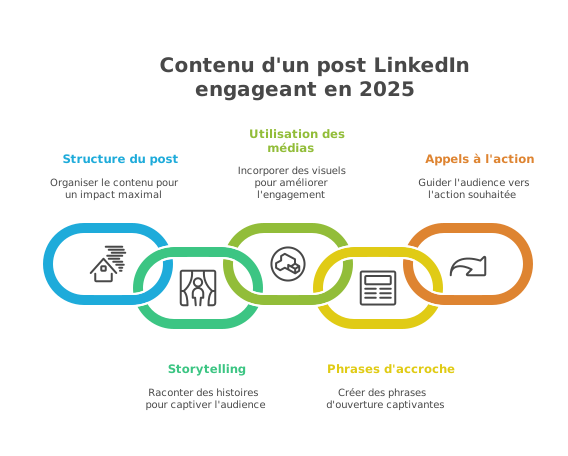
In 2026, LinkedIn is no longer just a network: it is a professional media outlet where depth and added value in content take precedence.
Newsletters, articles, carousels, or multi-format content: capturing attention and generating high-quality engagement is the key. With the right strategy, consistency, and the appropriate format, every post becomes a lever for your visibility, your personal brand, and your professional network.
Combining formats to maximize impact
The effectiveness of a LinkedIn strategy relies less on an isolated format than on the synergy between multiple formats. The algorithm values editorial diversity, and audiences engage more when they consume complementary content.
Why combine formats?
- Boost retention : a message presented in multiple formats (text, visual, video) is more memorable.
- Reach different audience profiles : some prefer to read, while others prefer watching a video or scrolling through a carousel.
- Increase touchpoints : the same topic can be adapted into several formats to extend its reach.
Alternating formats sends a positive signal to LinkedIn: you are producing diverse content that keeps users engaged. This helps to:
- Expand distribution (reaching different segments).
- Improve the overall dwell time on your profile/page.
- Strengthen your credibility as a well-rounded, multi-channel content creator.
No content without a LinkedIn content strategy
Posting on LinkedIn without a clear strategy is like sailing without a compass: you risk producing content that reaches neither the right audience nor the right goals.
In 2026, competition is so fierce that posting regularly is no longer enough: you need to know why, for whom, and with what positioning.
Defining your goals, understanding your audience, and establishing a consistent editorial line are the three pillars of a high-performing LinkedIn strategy:
Book a meeting with the team
When and how often should you post?
Performance depends not only on content, but also on when and how frequently you post.
A. The best days and times in 2026
- Optimal days : Tuesday, Wednesday, and Thursday remain the most effective, as the audience is professionally active.
- Key times :
- Morning (7:30 AM–9:00 AM): reading before work.
- Early afternoon (12:00 PM–2:00 PM): mobile browsing during lunch.
- End of the day (5:00 PM–6:30 PM): active time before winding down.
- 2026 Trends : a rise in evening engagement (8:00 PM–10:00 PM), particularly on mobile, for more inspirational or personal content.
B. The ideal posting frequency
- Freelancers / content creators : 3 to 4 posts per week to stay visible without overwhelming your audience.
- Businesses : 2 to 3 posts per week, combining corporate content (news, offers, events) with employee-generated content shared by staff.
The key: prioritize consistent quality over excessive quantity, and above all,originality.
Conclusion: looking beyond the content
Creating LinkedIn content in 2026 means first and foremost understanding that the platform has moved beyond a simple publishing-only approach it is becoming a true testing ground for strategy.
It is no longer just the quality of your posts that matters, but how they fit into a broader dynamic — brand storytelling, customer acquisition, recruitment, influence, and even thought leadership.
The challenge for the months and years ahead will be to take this thinking further:
- how can you integrate LinkedIn into a multichannel strategy that interacts with other networks, external newsletters, in-person events or podcasts?
- How can you leverage AI to optimize performance without losing theauthenticity that makes a profile stand out?
- And above all, how can you turn digital engagement into concrete, lasting relationships that serve your professional goals?
LinkedIn is just one piece of the puzzle: it is up to you to decide how to connect it with the rest of your digital and human ecosystem to make it a true opportunity accelerator.

Mathieu Pimort


Have questions?

Other resources LinkedIn & Media Relations
%20Large.avif)
Go from invisible to essential in your market
Your expertise deserves to be visible, credible, and shared, both on LinkedIn and in the media.

LinkedIn communication and Public Relations agency in Paris.
