

What content interests journalists?

Article summary
- Journalists look for useful content, not advertising : exclusive figures, testimonials, case studies, original angles, and readable formats.
- The 4 criteria : relevance (editorial line), timing (their schedule), clarity (key info accessible), and personalization (avoiding generic blasts).
- What turns content into must-have news exclusivity, simplifying the journalist's workflow, a personalized approach, and long-term responsiveness.
Capturing the attention of a journalist has become a real professional challenge for companies.
Every day, newsrooms receive dozens of messages, but only a few make it onto a newspaper page, into an online publication, a news report, or a magazine feature.
Why? Because journalists, whether they are reporters, editorialists, or political journalists, work with specific expectations, dictated by their audience, their profession, their working conditions, and a professional code of ethics.
This guide helps you tell your story in a "journalistically relevant" way, to speak to the reader before speaking to the market, and to structure your content so that it gets used, read and even shared by the press.
Whether you are writing a press release, a press kit, a press review, or a message for an influencer, you will discover here the steps, the formats, the keywords and the questions to ask yourself to make an impact.
What journalists really want in 2025
Before creating content, it is essential to understand the practices, constraints, and expectations of journalists, particularly in sectors like IT where information is abundant but attention is scarce.
Who are journalists and how do they work?
The mission of journalists is to inform, which involves sorting, verifying, and prioritizing information from multiple sources.
They work under pressure, with tight deadlines, and look for clear, reliable, and contextualized content. However, they do not all have the same profile:
What types of content grab their attention?
They prioritize value-added content : exclusive data, client testimonials, case studies, concrete news, original angles, readable formats...
"Useful content" takes precedence over "promotional content."
The main criteria for "good" content for them:
- Relevance (content adapted to their editorial line),
- Timing (synchronized with their schedule),
- Clarity (key information quickly accessible),
- Personalization (avoiding generic outreach).
We explore these points in more detail below.
The different types of content that appeal to journalists
Capturing a journalist's attention is about more than just sending a simple press release. Each content format — press release, press kit, press review, media kit — meets specific expectations and plays a strategic role in media relations.
Understanding their nuances means maximizing your chances of media coverage and strengthening the credibility of your message.
Press release, press kit, press review, media kit: what are the differences?
Here is a summary table of the different formats and their objectives:
How to create content that truly interests journalists
As we have already mentioned, an editorial team receives on average dozens of pitches per day.
To have any hope of capturing their
attention, your PR content must not only be relevant, but also tailored to their needs and constraints : news value, angle, clarity, and added value. Here is the four-step method.
Define the editorial line and the content angle
The angle is key : it guides the journalistic approach and determines whether your information will lead to an article or end up in the trash.
- Objective : find an angle that serves both your strategy and the media outlet's editorial interests.
- Method :
- Identify the core message (just one, clear message).
- Ask yourself, "Why this topic today?" (the timeliness criterion).
- Connect your topic to a trend, a striking figure, or a key industry issue.
In practical terms, the topic will be adapted for different formats as follows:
Capture attention with structured, readable content
Journalists scan before they read.
Beyond the substance, a clear and visually open format increases your chances of being read, for example by using:
- Hierarchical headings and subheadings.
- Short, punchy quotes.
- Key figures highlighted visually.
- Images and charts to illustrate the information.
Avoid common mistakes in your PR content
A relevant topic does not guarantee media coverage. How it is presented plays an equally decisive role.
Journalists filter quickly content that doesn't meet their editorial criteria. The result: information that is poorly presented, too vague, or too focused on self-promotion often ends up... in the trash.
Ask yourself if the angle is clear from the headline, if you have provided a concrete detail that intrigues or surprises, and finally, if a journalist could rewrite your story in 10 minutes with what you have provided.
The main mistakes to avoid:
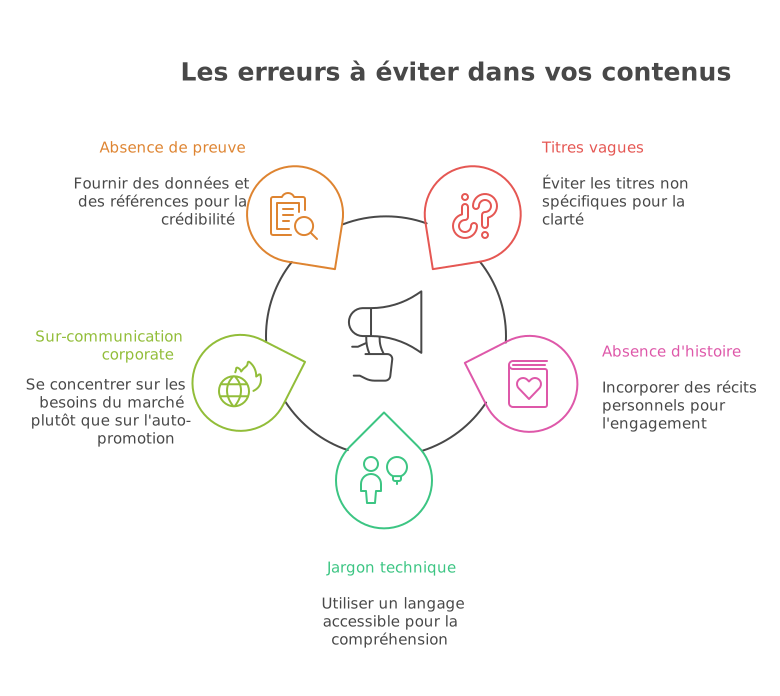
The "extras" that turn simple PR content into news that is anticipated and shared.
Exclusivity which creates the feeling that "this is for you and no one else" by offering a scoop or previously unpublished figures, or by providing early access to a study, a testimonial, or a prototype...
Simplification of the content to make the information immediately usable (text structure, visuals, FAQs...). Anticipate the journalist's needs.
Personalization of the information:
- Adapt the angle to suit the media outlet's editorial line.
- Mention a recent article by the journalist and create a link to your topic.
- Use a personalized and catchy email subject line.
Editorial supplements. Go beyond the raw facts by providing industry perspective, varied quotes from experts or executives, or a glossary for highly technical topics...
Responsiveness and long-term follow-up:
- Respond quickly to follow-up requests.
- be available for urgent commentary on a current event related to your sector.
- Regularly update your media kit.
You can also send additional information that is unsolicited but relevant in the days following your initial outreach (e.g., a new figure or a related visual). But don't be pushy.
Is it a good idea to call journalists?
Yes… but with tact. Making a phone call can be an excellent way to build a more human connection, get immediate feedback, or follow up on a topic you care about. A well-timed call can turn a simple "seen" into an actual publication.
But be careful, it’s a double-edged sword: if you call at the wrong time—during a deadline, a press conference, or between tight schedules—you risk closing more doors than you open.
The key is in the approach:
- Always start by introducing yourself clearly, then get straight to the point : journalists don't have time for long-winded speeches.
- Politely ask if it’s a good time to talk and be prepared to accept a "no" with a smile, even if it’s a bit forced.
In short: reach out to be helpful, not just to tick a box, and remember that in public relations, patience and respect are often worth more than persistent follow-ups.
Final tips: timing, channel, and targeting
Even the best press release in the world—clear, structured, illustrated, and print-ready—can end up at the bottom of an inbox if the timing, target, or channel are poorly chosen.
In PR, it’s often said that the key to success is distribution. The rest? Coffee, patience… and a well-maintained contact list.
When should you send PR content?
The question of timing is almost as crucial as the content itself. Sending a press release at 6 p.m. on a Friday… is a bit like announcing a flash sale at midnight.
- Before an event : ideal for giving journalists time to prepare their stories.
- Breaking news : react quickly to a relevant news topic to ride the wave.
- Quiet periods : take advantage of "editorial lulls" (summer, between Christmas and New Year) to pitch less urgent topics.
- Strategic days and times : often Tuesday or Wednesday morning, between 9 a.m. and 11 a.m. (avoid Monday at 9 a.m.… it’s a time for mass email clearing).
Who should you send your content to?
Sending a press release to "everyone" often means sending content that isn't relevant to some recipients. It’s not that they’ll hate it, but… they won’t do anything with it. Instead, use:
- A qualified database : names, media outlets, beats, and up-to-date contact information (even your favorite journalist might change newsrooms).
- Segmentation : trade press, general interest, business, local… tailor your angle and presentation accordingly.
- Existing relationships : maintain connections with journalists who already know you by regularly providing them with useful information.
Finally, how should you send your press kit or release?
Your email is your first impression : it needs to be compelling enough to get opened… and to keep their attention.
A journalist will decide in a matter of seconds whether to keep reading or archive your message. The choice of distribution channel plays a key role in this first point of contact.
In short, to capture a journalist's interest in 2025, you need to:
- Understand their editorial focus and constraints : target the right media outlet and section with a relevant message.
- Find a strong, original angle : a scoop, unique data, a compelling testimonial, or an industry trend that resonates with the outlet's audience.
- Provide clear, structured, and readable content : hierarchical headings, highlighted key figures, relevant visuals, and concrete quotes.
- Offer added value, not advertising : case studies, client testimonials, industry analysis, exclusive data, etc.
- Personalize your approach : direct messaging, referencing the journalist's previous work, and tailoring the topic to the outlet.
- Be responsive and available : answer questions quickly, provide useful supplementary information, and maintain an ongoing, trusting relationship.
- Use the right channel at the right time : personalized emails for key targets, PR tools for broad distribution, and media platforms for visibility.
- Respect editorial timing : avoid poorly timed pitches; prioritize quiet periods or topics tied to current events.

Mathieu Pimort


Have questions?

Other resources LinkedIn & Media Relations
%20Large.avif)
Go from invisible to essential in your market
Your expertise deserves to be visible, credible, and shared, both on LinkedIn and in the media.

LinkedIn communication and Public Relations agency in Paris.
