

How to stay visible on LinkedIn in 2026: 3 rules to adapt to the new algorithm

Article summary
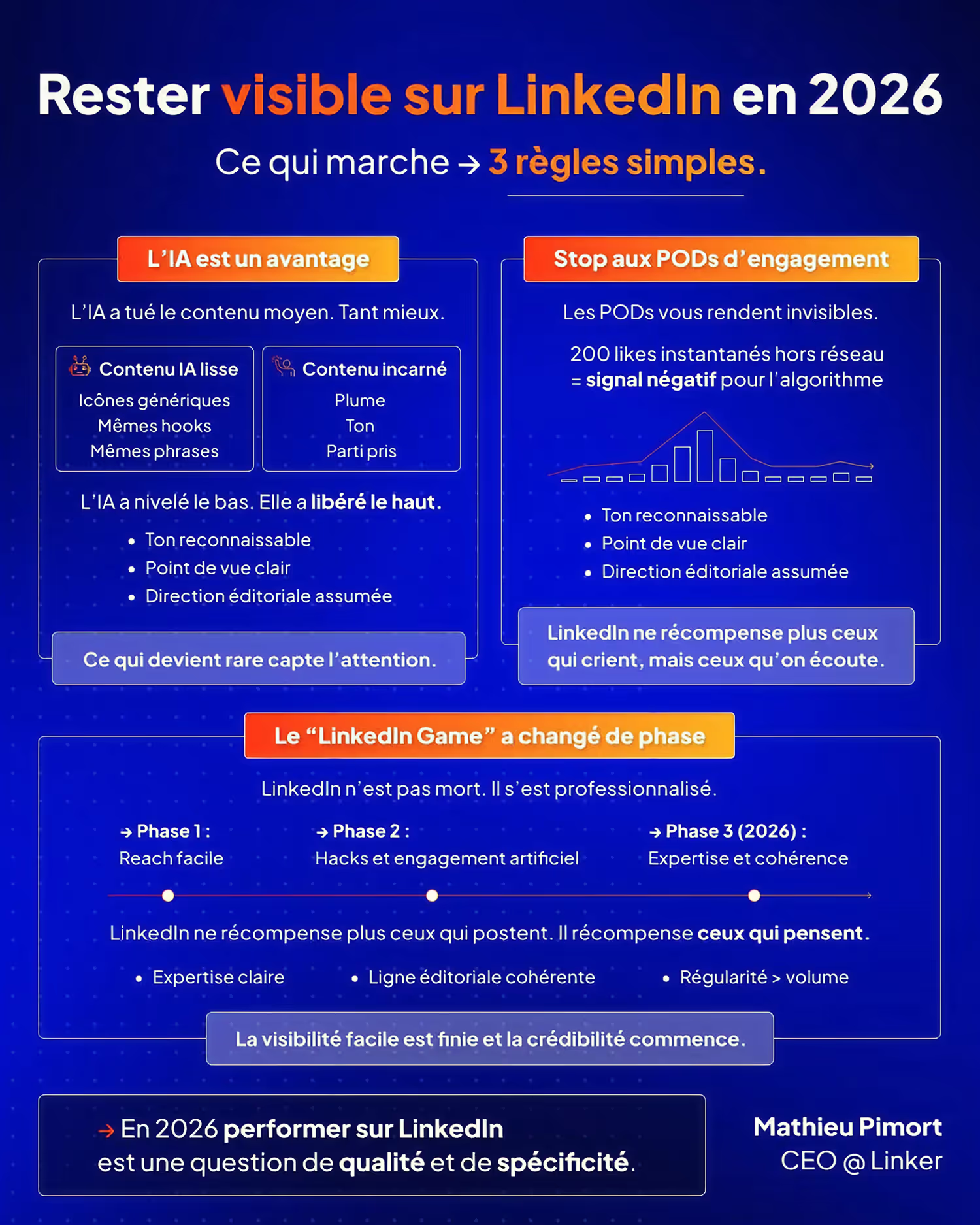
- The LinkedIn algorithm has entered phase 3 : it no longer rewards volume or hacks, but clear expertise, editorial coherence, and reading time (dwell time).
- Rule 1 : AI has killed average content. With a recognizable tone and a bold point of view, you come out stronger. Rule 2 : stop using engagement pods; LinkedIn detects and penalizes them.
- Rule 3 : LinkedIn rewards those who are listened to, not those who shout. Lasting visibility comes from coherence and consistency, not intensity.
January 2026. The first month of the year. You scroll through your LinkedIn feed and see the same soulless, AI-generated content. The same recycled hooks. The same engagement groups mechanically activating under every post.
Except the LinkedIn algorithm changed in 2025. Deeply. And if you don't adapt now, you will disappear from the feeds of your prospects, your talent, and your ecosystem.
Here are 3 rules to apply right now to stay visible on LinkedIn in 2026.
LinkedIn in 2026: the algorithm has entered phase 3
To understand where we are, we have to look back. LinkedIn hasn't always worked the way it does today. The platform has gone through three distinct phases, each with its own set of rules.
Phase 1 (2015-2020): Easy reach
Few people were posting on LinkedIn. Those who dared to speak up gained massive organic visibility. No special technique was needed: just posting was enough to reach thousands of people. It was the golden age of the "first mover advantage."
Phase 2 (2020-2024): Hacks and artificial engagement
LinkedIn became mainstream. Millions of people started posting. Easy visibility vanished. To compensate, creators developed optimization techniques: catchy hooks, copy-paste lists, engagement groups (pods), and specific formatting. It worked... for a while. But the algorithm remained immature, and these hacks created an environment of standardized, interchangeable content.
Phase 3 (2025-2026): Expertise and consistency
LinkedIn is entering a phase of algorithmic professionalization. The platform no longer wants to reward those who shout the loudest or use engagement hacks. It wants to reward those people actually want to listen to. Goodbye to easy visibility. Make way for clear expertise, editorial consistency, and qualitative regularity.
LinkedIn no longer rewards those who post. It rewards those who think.
Rule 1: AI is an advantage, not a problem (if you have a recognizable tone)
The reality: AI has killed average content
Artificial intelligence has created an ocean of smooth, interchangeable content. Posts generated in seconds, using the same structures, the same icons, and the same empty phrases. The problem isn't AI as a tool. The problem is the uniformity it has created.
The result: average content has become invisible. If your post looks like 10,000 other posts published on the same day, the LinkedIn algorithm won't promote it. Why would it?
The good news: AI has liberated the top tier
But here is the opportunity: AI has leveled the bottom, and it has liberated the top. If you are among the 10% who produce truly differentiated content, you stand out even more strongly than before.
Why? Because personality is becoming rare, and what is rare captures attention. In an ocean of generic content, a post with a real voice, a real point of view, and a real editorial direction becomes immediately noticeable.
The 2026 LinkedIn algorithm prioritizes what generates dwell time: the time people spend reading your post, re-reading it, and engaging with it. Generic AI content? Dwell time = 3 seconds. Content with a personal touch and a recognizable tone? Dwell time = 45 seconds. The algorithm sees this difference. And it rewards the latter.
How to stand out in 2026
To stand out from the crowd, you need to work on three dimensions:
1. Recognizable tone
Your writing, your voice, your convictions. People should be able to recognize you before they even read your name. This isn't about literary style; it's about authenticity. Speak the way you think. Not the way ChatGPT thinks you should speak.
2. Clear point of view
Commit to an editorial direction. Don't stay in the middle ground where "everyone agrees." Take a stand. Defend a vision. Even if it doesn't please everyone. That is precisely what creates engagement.
3. Bold perspective
Don't be bland. Bland posts don't generate reactions. Posts with a strong angle do. You don't have to be provocative, but you must be clear about what you stand for.
Concrete examples:
❌ Bland AI content:
"5 tips to succeed on LinkedIn in 2026 🚀"
✅ Authentic content:
"Why I no longer believe in LinkedIn hacks (and what I do instead)"
The first is interchangeable. The second carries a vision.
Rule 2: Stop using engagement pods (LinkedIn sees you, and it penalizes you)
What is an engagement pod?
A pod (or engagement group) is a private group (on Telegram, WhatsApp, or Slack) where members agree to like and comment on each other's posts to "boost" the algorithm. The promise: "200 guaranteed likes in 1 hour to maximize your reach."
It sounds clever. It isn't.
Why LinkedIn detects (and penalizes) them
LinkedIn has stated it clearly: "We identify accounts that use pods and we penalize them heavily."
How does LinkedIn detect these groups? Through several algorithmic signals:
1. Instant likes from outside your network
200 likes arriving in 10 minutes, all from 3rd-degree connections or further, with whom you have never interacted? It's a dead giveaway. LinkedIn sees that these people are not part of your natural ecosystem.
2. Near-zero dwell time
These people like without reading. The time spent on your post = 0 seconds. For the algorithm, this is a negative signal. It indicates that the content isn't engaging, even if it has a lot of likes.
3. Inconsistent network bubbles
LinkedIn analyzes "bubbles": your natural ecosystem (colleagues, clients, partners, people in your industry). If 90% of the engagement comes from people outside these bubbles, it's suspicious.
The consequences
LinkedIn doesn't delete your account. It does something worse: it drastically reduces your visibility. Your posts are shown to fewer and fewer people. You go from 5,000 impressions to 300. And you don't understand why.
Plus, your credibility takes a hit. When your posts show 200 likes but only 3 relevant comments, people notice. And they understand.
What works instead
Organic engagement: create content that naturally makes people want to comment. Ask real questions. Share your stance. Tell stories.
Network consistency: the right people (your natural ecosystem) engage with you because your content genuinely interests them.
High dwell time: readers stay, read to the end, reflect, and then engage. It's this time spent that counts for the 2026 algorithm.
Rule 3: LinkedIn rewards those who are listened to, not those who shout
The new 2026 LinkedIn algorithm: expertise and consistency
The 2026 LinkedIn algorithm analyzes three main dimensions:
1. Clear expertise
LinkedIn checks if you have an identifiable positioning. What do you talk about? With what authority? Are your posts consistent with this positioning, or are you just talking about anything and everything?
A SaaS CEO who alternates between product management, cooking, and personal development sends a confusing signal. A SaaS CEO who consistently talks about go-to-market, product-market fit, and B2B growth sends a clear signal. The algorithm favors the latter.
2. Consistent editorial line
Do your posts follow a common thread, or are you posting opportunistically? LinkedIn analyzes consistency over time. If every post reinforces your positioning, your visibility increases. If your posts are all over the place, it decreases.
3. Consistency > volume
It is better to have 2-3 well-thought-out, structured, and authentic posts per week than 5 generic posts published just for the sake of posting. The algorithm no longer just counts posts. It measures their quality through dwell time and qualified engagement.
What works in 2026
✅ Recognizable tone: your voice, not ChatGPT's.
✅ Clear point of view: you champion a vision, not a compilation of generic advice.
✅ Decisive editorial direction: every post reinforces your positioning.
What no longer works
❌ Recycled hooks: "You're making this mistake on LinkedIn" (seen 10,000 times).
❌ Copy-pasted lists: "10 AI tools you need to know" (already done everywhere).
❌ Opportunistic content: jumping on every trend without a common thread.
How to adapt your LinkedIn strategy in 2026
If you want to stay visible (or become so) on LinkedIn in 2026, here is the method to follow.
1. Clarify your positioning
Before publishing a single post, answer these three questions:
- What are you talking about? (3-4 topics maximum, not 15)
- What is your specific angle? (your vision, not everyone else's)
- What is your credibility? (expertise, experience, concrete results)
Without these answers, you will produce generic content that leads nowhere.
2. Build a consistent editorial line
Once your positioning is clear, build your editorial line:
- Alternate formats: vision, behind-the-scenes, learnings, case studies, and takes.
- Keep a common thread: every post must reinforce your positioning.
- Don't post "just to post": every piece of content must provide value. If you have nothing to say that day, don't publish.
3. Prioritize quality over quantity
2-3 well-thought-out posts per week are better than 5 generic ones. Take the time to structure your posts:
- Hook: grab attention in one sentence.
- Body: develop your idea, provide evidence, and use examples.
- Conclusion: wrap up with a clear message.
Focus on the format: tone, rhythm, and readability. A dense but unreadable post will not be read.
4. Create organic engagement
To generate natural (not artificial) engagement, you need to make people want to react:
- Ask real questions (not rhetorical ones).
- Share your stance (own your convictions, even if they aren't universally popular).
- Tell stories (not lists of generic advice).
5. Be consistent (not opportunistic)
Consistency builds trust and algorithmic recognition. Build a monthly editorial calendar. Don't just post when you have news to announce. Post because you have something to say.
The Linker approach to staying visible on LinkedIn in 2026
At Linker, we help CEOs and executives structure their LinkedIn communication according to the new 2026 algorithm rules.
Our method:
Positioning framework: we clarify your 3-4 key topics, your specific angle, and your authority. No clear positioning = no lasting visibility.
Editorial line development: we define themes, alternate formats, and create a consistent narrative thread. Every post reinforces your expertise.
Ghostwriting or coaching Depending on your preferences, we can write your posts for you (using your own voice, not a generic one) or train you to write them yourself using a proven method.
LinkedIn + PR Coordination: we orchestrate your messaging so that LinkedIn and Public Relations reinforce each other. Every piece of press coverage becomes a LinkedIn post. Every interview is repurposed.
Our approach: quality, consistency, regularity.
No hacks. No engagement pods. No generic AI content. Just a clear, authentic strategy aligned with the 2026 algorithm rules.
Looking to structure your LinkedIn communication for 2026? Book a meeting with the Linker team for an initial strategic discussion.

Viktor Cohen


Have questions?

Other resources LinkedIn & Media Relations
%20Large.avif)
Go from invisible to essential in your market
Your expertise deserves to be visible, credible, and shared, both on LinkedIn and in the media.

LinkedIn communication and Public Relations agency in Paris.
