

Expanding into Europe: which country should you start with?
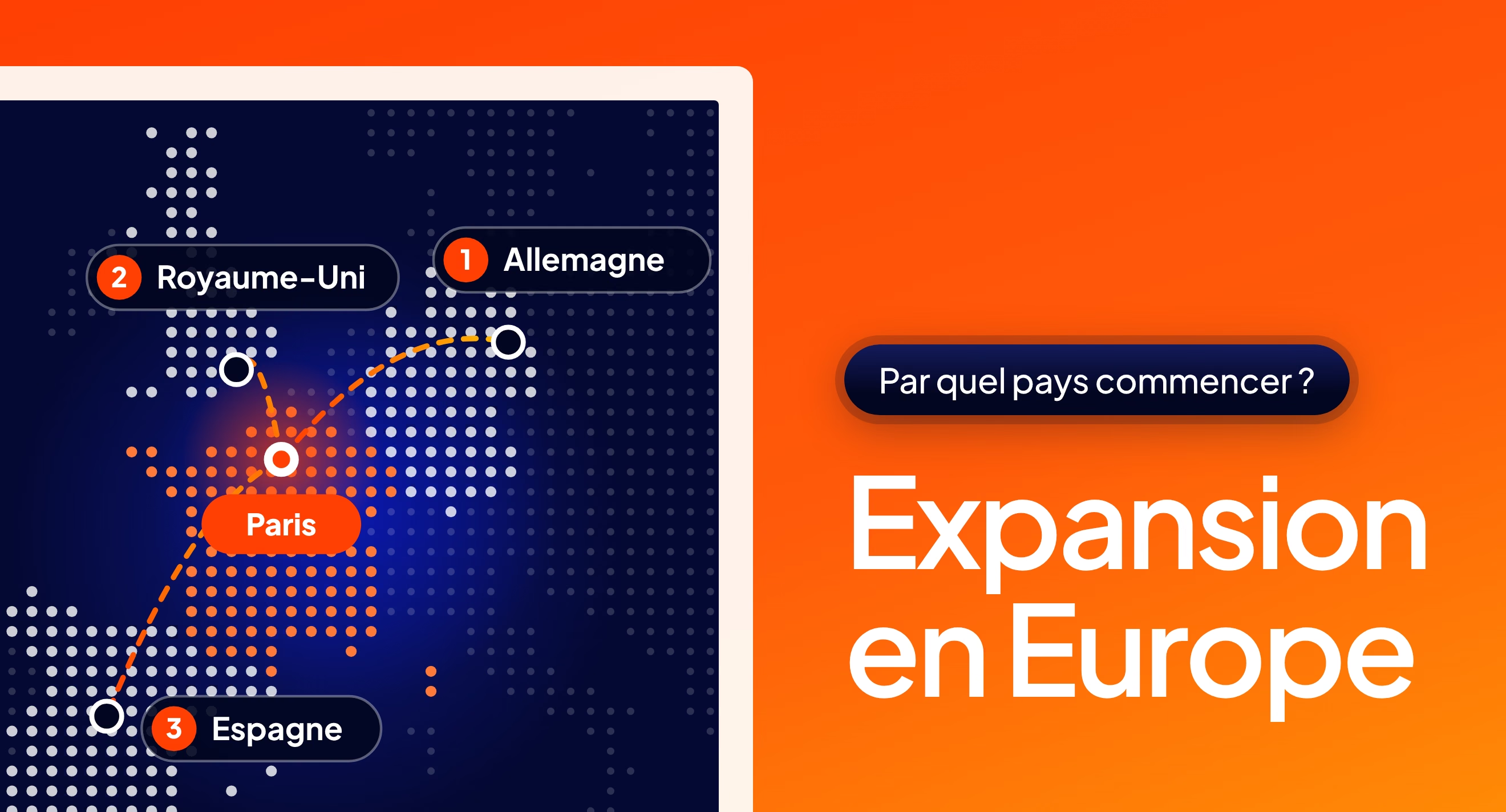
Article summary
- Choose your first European market on existing demand: open the country your inbound leads already come from, not the biggest one.
- London attracted $23.6bn of venture capital in the 12 months to September 2026, according to Dealroom, but the UK is outside the single market.
- The Netherlands, ranked 1st in the EF EPI 2025, and Sweden let you sell and hire in English. Germany, Spain and Italy require working in their language.
- Visibility belongs in the choice: trust in news ranges from 29% in France to 52% in Sweden, according to the Reuters Institute (2026).
- Pan-European media (Sifted, Tech.eu, EU-Startups) build credibility with investors. National press gets you customer meetings.
Your first European market should be chosen on three criteria: where your inbound leads already come from, the language in which you can sell and get press coverage, and the cost of entry. The UK has the most venture capital but sits outside the EU, the Netherlands and Sweden let you operate in English, and Germany is a volume market rather than a first test. Here is the data, country by country, and a simple rule to decide.
Last updated: November 2026.
What criteria should decide your first European market?
Six criteria separate the candidates. Most expansion guides cover the first five. The sixth, visibility, is usually missing.
- Existing demand. Inbound leads, first customers, partners asking you to come. It weighs more than anything else, and no statistic can measure it for you.
- Market size. Population and GDP tell you how far the country can carry you once the offer works.
- Language. The language of your buyers and of the newsrooms, and how widely English is spoken.
- Local capital. Venture capital invested locally matters if you plan to raise there, or to hire people trained by scale-ups.
- Cost of entry. The cost of a local team, and whether the country is inside the EU single market.
- Visibility. Which media matter, which language they work in, and how much the public trusts them.
A startup nobody knows takes time to win its first local customers, hires and investors. Press coverage and the founder's LinkedIn shorten that time. That is why visibility belongs in the choice of country, not only in the launch plan.
How do the UK, Germany, Spain, Belgium, the Netherlands, Sweden and Italy compare?
The table brings together the latest public data for seven markets that tech startups often consider first, with France as a benchmark. Venture capital is shown by city, because Dealroom only publishes its ranking of Europe's top ten tech cities openly.
| Country | Population | GDP 2025 | Venture capital, top tech city or cities (12 months to Sept 2026) | English (EF EPI 2025) | Hourly labour cost 2025 | In the EU |
|---|---|---|---|---|---|---|
| UK | 69.5m (mid-2025) | £3,045bn | London $23.6bn; Cambridge $2.1bn | Official language | Not published by Eurostat | No |
| Germany | 83.6m | €4,530bn | Munich $6.0bn; Berlin $2.9bn | 615 (4th worldwide, very high) | €45.0 | Yes |
| Spain | 49.1m | €1,690bn | Barcelona $1.4bn; Madrid $0.9bn (Jan-Sept 2026) | 540 (moderate) | €26.4 | Yes |
| Belgium | 11.9m | €641bn | No city in the top ten | 608 (very high) | Not released for 2025 | Yes |
| Netherlands | 18.0m | €1,171bn | Amsterdam $2.2bn | 624 (1st worldwide, very high) | €47.9 | Yes |
| Sweden | 10.6m | €600bn | Stockholm $5.2bn | 609 (very high) | €43.1 | Yes |
| Italy | 58.9m | €2,265bn | No city in the top ten | 513 (moderate) | €32.0 | Yes |
| France (benchmark) | 68.9m | €2,991bn | Paris $10.4bn | 539 (moderate) | €44.3 | Yes |
Sources: Eurostat (population on 1 January 2025, 2025 GDP and 2025 hourly labour costs, accessed November 2026); ONS for the UK (mid-2025 population, 2025 GDP); Dealroom Europe guide, updated 12 October 2026 (venture capital over the 12 months to end of September 2026); EF English Proficiency Index 2025, published 19 November 2025. Eurostat has not released Belgium's 2025 hourly labour cost.
UK: Europe's largest tech ecosystem, outside the EU
London attracted $23.6bn of venture capital in the 12 months to September 2026, more than Paris, Munich and Stockholm combined ($21.6bn), according to Dealroom. English makes selling, hiring and press work easier for any international team. But the UK is no longer in the single market: entity, VAT, contracts and data transfers need separate handling. It is the right first market if your customers or investors are already there, or if your product and team already work in English.
Germany: a volume market, rarely a first test
With 83.6 million people and €4,530bn of GDP in 2025 according to Eurostat, Germany is the EU's largest market. Its ecosystem is split between Munich ($6.0bn of venture capital over 12 months) and Berlin ($2.9bn), according to Dealroom. English is widely spoken, with Germany ranked 4th in the EF EPI 2025, yet B2B buyers, contracts and the business press work in German. Plan German-language materials and a German-speaking spokesperson. Germany usually works better as a second step, once the offer is proven in a smaller market.
Spain and Italy: close and cheaper, but in their own language
Hourly labour costs were €26.4 in Spain and €32.0 in Italy in 2025, against €44.3 in France and €45.0 in Germany, according to Eurostat. Barcelona raised $1.4bn over 12 months and Madrid $877m in the first nine months of 2026, according to Dealroom; no Italian city makes the top ten. English proficiency is “moderate” in the EF EPI 2025 (540 for Spain, 513 for Italy). Sales, press and hiring happen in Spanish and Italian: cultural proximity does not replace the language.
Belgium and the Netherlands: the closest test
Belgium (11.9 million people) lets you start in French in Brussels and Wallonia, but Flanders buys and reads in Dutch. The Netherlands (18.0 million people) ranks 1st in the world in the EF EPI 2025, so you can sell and hire in English from day one. Amsterdam attracted $2.2bn of venture capital over 12 months, according to Dealroom. The trade-off: Dutch hourly labour costs reached €47.9 in 2025, among the highest in the EU, according to Eurostat.
Sweden and the Nordics: small, English-speaking and well funded
Stockholm is Europe's 4th tech city by venture capital, with $5.2bn over 12 months, ahead of Berlin and Amsterdam, according to Dealroom. Helsinki ($2.0bn) and Copenhagen ($1.6bn) complete the top ten. Sweden has only 10.6 million people: it is a place to validate a product and meet investors, while volume comes from elsewhere. English is widely spoken, with a score of 609 in the EF EPI 2025.
Which country gives a startup the best press visibility?
Pan-European English-language media are the widest door. At national level, the business press works in the local language, and that is what your buyers read. The next table lists the reference media in each market, the newsroom language and how much the public trusts news.
| Country | Reference tech and business media | Newsroom working language | Trust in news (2026) |
|---|---|---|---|
| UK | Financial Times, City A.M., UKTN, Sifted (London-based) | English | 30% |
| Germany | Handelsblatt, Gründerszene, t3n, Deutsche Startups | German | 46% |
| Spain | Expansión, Cinco Días, El Referente | Spanish | 33% |
| Belgium | L'Echo, De Tijd, Data News | French and Dutch | 39% (49% Dutch speakers, 28% French speakers) |
| Netherlands | Het Financieele Dagblad, Emerce, Silicon Canals (in English) | Dutch, English for Silicon Canals | 49% |
| Sweden | Dagens Industri, Breakit | Swedish | 52% |
| Italy | Il Sole 24 Ore, StartupItalia, EconomyUp | Italian | 32% |
| Pan-European | Sifted, Tech.eu, EU-Startups | English | Not measured |
Sources: media websites; Reuters Institute Digital News Report 2026, published 16 June 2026 (about 2,000 respondents per market, share who trust most news most of the time).
Trust in news nearly doubles from one European market to another: 52% in Sweden and 49% in the Netherlands, against 30% in the UK and 29% in France, according to the Reuters Institute. In Belgium the gap is internal: 49% among Dutch speakers, 28% among French speakers. Coverage in a market where people trust the news is more likely to reassure a buyer who has never heard of you.
LinkedIn crosses borders. In Cision's State of the Media 2026, 62% of journalists said they use LinkedIn in their work and 33% called it the most useful platform. A founder who posts in English about their market is visible in every target country at once, before any local team exists. For execution market by market (media lists, newsroom codes, timing), see our guide to structuring your PR across Europe.
Should you target pan-European media before national media?
Yes for credibility, no for sales. Sifted, Tech.eu and EU-Startups write in English for a European readership: one article reaches investors, talent and partners in all your target countries. They are also the sources AI assistants rely on. In our ChatGPT tracking in October and November 2026, on the question “How can a French startup get press coverage abroad?”, sifted.eu, tech.eu and eu-startups.com each appeared among the sources of 3 answers out of 4.
The limit: a German CFO or a Spanish HR director reads their national and trade press, not Sifted. Pan-European coverage prepares the ground; national coverage gets you meetings. Plan both, pan-European first if your priority is fundraising or hiring, national first if it is revenue. Our map of French tech media by beat applies the same logic to France.
Which first market fits your startup's profile?
The starting rule: open the market your inbound leads already come from. If no country stands out, the table below works as a reading grid. It is drawn from the two previous tables: each row matches a situation with the data point that separates the countries.
| Your situation | First market to consider | Deciding data point (tables 1 and 2) | Signal that should change your mind |
|---|---|---|---|
| Your inbound leads already come from one country | That country | Existing demand outweighs every other criterion | Leads from that country do not sign despite local follow-up |
| Product and team in English, no localisation budget | Netherlands, Sweden | Very high English proficiency (EF EPI 2025) and local capital: Amsterdam $2.2bn, Stockholm $5.2bn | Buyers require contracts or support in the local language |
| Fundraising or international hiring comes first | UK | London concentrates $23.6bn of venture capital over 12 months | The cost of a non-EU entity exceeds what your stage allows |
| French-speaking B2B sales, minimum risk | Belgium (Brussels, Wallonia) | Same language, single market, shared border | Your targets are mostly in Flanders, which buys in Dutch |
| Offer proven, looking for volume | Germany | Largest GDP in the EU: €4,530bn in 2025 | No German-speaking spokesperson or materials |
| Lowest-cost local team | Spain | Hourly labour cost of €26.4 in 2025 | No capacity to sell and communicate in Spanish |
Which mistakes slow down a first European market?
Six mistakes come up again and again when a startup opens its first country.
- Opening three countries at once. Budget, founder attention and PR effort are split three ways, and no market reaches the point where people recognise you.
- Picking the biggest market rather than the one asking for you. Germany's size is worth little if your inbound leads come from Belgium.
- Translating instead of rewriting. A translated press release has no local customer, no local figure and no local spokesperson.
- Mixing up investor credibility and customer credibility. A Sifted article reassures a fund; it rarely convinces a national buyer.
- Arriving without a spokesperson. A journalist who takes your story needs someone to interview that week, ideally in their language.
- Forgetting the UK is outside the EU. Hiring, invoicing and data no longer follow single-market rules.
The same reasoning applies beyond Europe: our US PR guide and our analysis of 10 French startups that broke through in the US show what changes across the Atlantic.
How Linker supports a startup in its first European market
Linker is an independent PR and LinkedIn agency founded in Paris in 2022, working with tech startups and scale-ups. For a European expansion, the agency works with pan-European English-language media and on the founder's LinkedIn in English. It also works with a number of European media outlets, including in Spain, the UK and Belgium.
For WeAreEurope, Linker secured more than 50 press pieces across Europe in three months, including 11 in France, with titles such as Politico, The Guardian, La Vanguardia and Les Échos (see the WeAreEurope case study).
To compare your options, see our ranking of the best European PR agencies for tech.
Where to start this week?
List your inbound leads and foreign customers from the last 12 months, by country. If one country stands out, that is your first market. If not, find your profile in the reading grid above, then check that you have a spokesperson who can answer that country's press. To prepare your first market with us, see how we support international expansion.

Viktor Cohen


Have questions?

Other resources LinkedIn & Media Relations


Go from invisible to essential in your market
Your expertise deserves to be visible, credible, and shared, both on LinkedIn and in the media.

LinkedIn communication and Public Relations agency in Paris.
